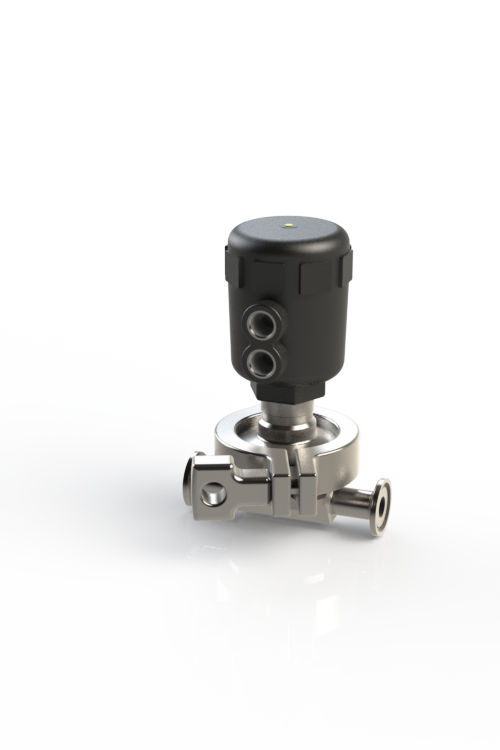
Every pneumatic valve is the visible end of an invisible system: a compressor, dryers, receivers, filters, regulators, and distribution that deliver clean, dry, stable air to the point of use. That system is easy to take for granted because it works and it is already there. The goal here is not to argue it away, it is to see it clearly as a utility, with its merits and its costs, so the decision to keep it or remove it is a deliberate one.
Why compressed air is the default
It earned the position
Pneumatic actuation did not become standard by accident. As a utility it has real, durable advantages.
- Proven and ubiquitous. Decades of validated hygienic service, supported by every major valve supplier, with deep institutional familiarity in operations and maintenance.
- Inherently fail-safe. A spring-return actuator drives the valve to a defined safe position the instant air is lost, with no stored energy required.
- Intrinsically safe. No electrical ignition source at the valve, which suits flammable and classified (ATEX) areas directly.
- Simple and robust at the valve. No electronics to fail in wash-down or harsh environments, and high actuation force from a compact package.
- Low marginal cost where it exists. Once the air system is installed and qualified, adding another pneumatic valve is inexpensive.
The costs teams underestimate
Air is a graded utility, not free
The trouble is that the air system's costs are mostly hidden in generation and distribution rather than at the valve, so they get discounted. Compressed air for critical use is specified to ISO 8573, which grades it for particles, water, and oil, and holding a class requires drying, multi-stage and point-of-use filtration, and monitoring. Along the way the air picks up oil carryover from the compressor, condensed moisture from the line, and the microbial load those conditions support, so any path by which it could reach product has to be assessed. Regulators drift over a long run, distribution networks leak, and per unit of useful work compressed air is among the most expensive utilities in a plant. None of this makes air unusable; it makes it a real cost that belongs in the comparison.
A utility you validate
The compliance scope is real on both sides
Because the air can affect or contact product, the air system carries qualification and monitoring scope: installation and operational qualification, routine testing against the ISO class, alarms, and a documented control strategy that expands with every critical point of use. It is also a common inspection focus. Electric actuation does not escape compliance work either, it brings its own qualification for the control system, software, and electronic records, so the honest framing is that each path carries a different validation burden, not that one is free.
What changes if you remove it
An electric valve needs a wire
Electric actuation replaces the air supply with a 24V DC line and a connector. Where it is adopted, a set of systems and scopes goes away with the air.
| The air loop brings | Removing it drops |
|---|---|
| Compressor, dryers, receivers, distribution | A generation and distribution system to design and maintain |
| Multi-stage and point-of-use filtration | Filter changeouts and their consumables |
| ISO 8573 qualification and monitoring | That standing testing and documentation burden |
| Oil, moisture, and microbial contamination paths | A contamination route to assess and control |
| Regulator drift and leak management | A source of control drift and energy loss |
The flip side, fairly stated: electric actuation adds electronics to maintain and a power-loss fail-safe strategy to design, and where a qualified air system already exists, much of the cost above is already sunk.
When to keep it, when to remove it
A decision, not a verdict
Keep compressed air where a qualified system already serves the area, where the duty is simple open and close, where an inherent spring-return fail-safe is the cleanest way to meet a safety requirement, or in classified spaces where avoiding an electrical source is the priority. Consider removing it for a new facility where the air loop would be built from scratch, where critical points of use demand precise control and process data that pneumatics cannot give, or where shrinking the validated-utility footprint is a deliberate compliance goal. The right answer is whichever leaves you with the smaller total cost and risk for the duties you actually run.
Common questions
Is compressed air a contamination risk in bioprocessing?
It can be, which is why critical air is graded to ISO 8573 and filtered at the point of use. Compressed air can carry oil carryover from the compressor, condensed moisture, and the microbial load those support, so any path by which it could reach product is assessed and controlled. Properly qualified, it is used safely throughout the industry.
What does it really cost to run compressed air?
Most of the cost is hidden in generation and distribution, not at the valve: the compressor and drying, multi-stage and point-of-use filtration, leak and regulator-drift management, energy (air is among the most expensive utilities per unit of useful work), and the ISO 8573 qualification and monitoring scope. Where the system already exists, much of this is sunk; for a new build it is all new.
When does it make sense to eliminate compressed air?
It makes sense for a new facility that would otherwise build an air loop from scratch, for critical points of use that need precise control and process data pneumatics cannot provide, or where reducing the validated-utility footprint is a goal. It makes less sense where a qualified air system already serves the area or where an inherent spring-return fail-safe is the cleanest safety solution.
What to read next
Response time, position accuracy, infrastructure, and predictive maintenance. A balanced, requirement-driven comparison.
Why ±X PSI on a datasheet is meaningless until you know what it does to filtration and chromatography.