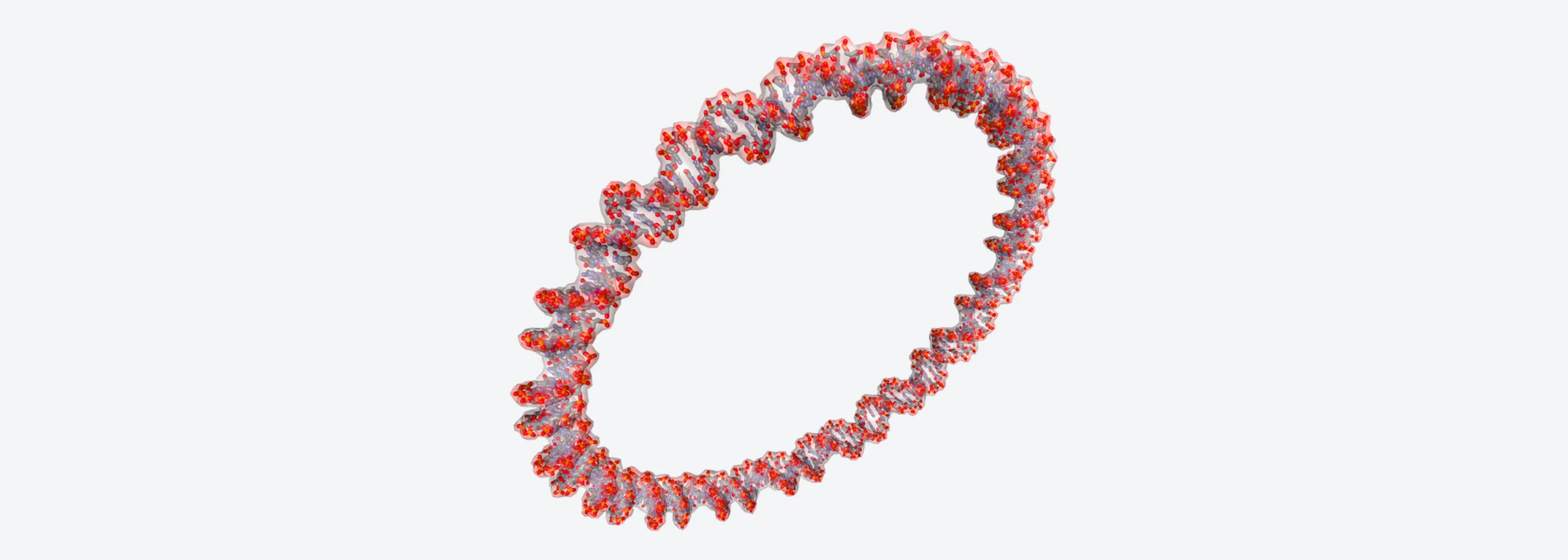
If you manufacture plasmid DNA, your specification is not really a mass number. It is an isoform number. Regulators and your mRNA and gene-therapy customers expect greater than 90% supercoiled content in the drug substance, and the supercoiled isoform is the potent, active species. The problem is that everything you do to concentrate and formulate the plasmid, from clarification through UF/DF, is a chance to nick a strand and relax that supercoiled DNA into the open-circular and eventually linear form. That is a potency loss, and it does not always show up on a total-DNA yield readout.
The physics is unforgiving. A therapeutic plasmid is typically 3,000 base pairs and up, often 7 to 15 kb for gene-therapy and DNA-vaccine constructs, and in solution it behaves as a long, semi-flexible polymer with a large hydrodynamic radius. It is far more vulnerable to fluid shear than a compact globular protein, and shear damage scales with plasmid length. The large constructs now driving gene therapy and mRNA-template supply are the most fragile of all. Protecting the supercoiled fraction is therefore a fluid-mechanics problem before it is a chemistry problem.
Damage accumulates wherever the fluid is worked hardest: pumps, valves, and any high-velocity or cavitating zone. Ultra scale-down studies specifically implicate pump and centrifuge operations as the dominant shear-damage steps for pDNA, which is why continuous disk-stack centrifugation is often avoided and developers lean toward gentler batch or filtration-based clarification. By the time the clarified, chromatography-purified plasmid reaches the concentration and formulation step, the fragility has not gone away. It has moved downstream to the one unit operation that runs the longest.
That step is UF/DF, tangential flow filtration used to concentrate the plasmid and exchange it into the final formulation buffer. Because pDNA is retained by a molecular-weight-cutoff membrane while buffer and small molecules pass as permeate, the plasmid is recirculated across the membrane and back through the pump for hours. The damaging quantity is not the peak shear of any single pass. It is the cumulative shear dose, shear per pass multiplied by the number of passes. A gentle-looking loop that runs long enough will still erode supercoiled content.
Three modality-specific hazards compound the dose:
| Hazard | Why it hurts Plasmid DNA |
|---|---|
| Rising viscosity | As pDNA approaches and exceeds roughly 10 mg/mL the solution turns markedly viscous, raising feed pressure and limiting flux. Pumps that stall, cavitate, or pulse on viscous feed concentrate mechanical damage exactly where the product is most concentrated and most valuable. |
| Air and foaming | Entrained air and foam expose plasmid to interfacial forces that nick and denature it. A closed, air-free flowpath and elimination of cavitation at the pump suction are process requirements, not niceties. |
| Unstable TMP | Pulsatile flow swings transmembrane pressure on every beat, stressing both the plasmid and the membrane and accelerating the concentration polarization pDNA is already prone to. Stable, near-pulseless flow is what protects supercoiled content across a multi-hour step. |
There is a real trade-off buried in the membrane choice too. Because pDNA fouls and polarizes readily, operators run at low TMP and low crossflow to protect the product, which lengthens the run and adds passes, compounding the cumulative-dose problem. Flat-sheet cassettes offer higher critical flux; hollow fibers are gentler. It is a genuine gentleness-versus-throughput tension, and the feedstream that arrives at UF/DF is punishing to begin with: clarified alkaline lysate that is often under 3% plasmid against roughly 97% chemically similar impurities. Every gentle-handling gain downstream is undone if the earlier steps have already shifted the sc/oc ratio.
Here is the part the market tends to leave generic. The big TFF suppliers frame gentleness as a property of the membrane, the cassette, or the fiber, and treat the recirculation pump as an interchangeable commodity. But for plasmid DNA, where the value species is destroyed by cumulative shear over hundreds of passes, the pump is the silent determinant of supercoiled yield. You can select the gentlest fiber on the market and still relax your plasmid if the pump driving the loop shears it, pulses the TMP, or cavitates on a viscous feed.
The lever no one talks about. In plasmid UF/DF the product passes through the recirculation pump hundreds of times. Cutting shear per pass is the single most direct way to keep supercoiled DNA from relaxing to open-circular. Choose the pump as carefully as you choose the membrane.
This is exactly what the pump fundamentals and TFF fundamentals point to: in a recirculating filtration loop, the fluid mover is not a supporting actor. It sets the shear environment the product lives in for the entire run.
TFFi, single-use tangential flow filtration, is the direct answer to the plasmid UF/DF step. It performs the exact operations pDNA needs, concentration, buffer exchange, and final formulation, across a 30 mL to 10 L range that spans process development through GMP clinical batches. Because the whole flowpath is single-use, you avoid the cleaning validation and cross-contamination risk of running a high-impurity, nuclease-prone feed through reused hardware, and you scale from PD to GMP without changing the shear environment the product sees. TFFi won the Interphex 2026 Best Technology Innovation award.
The load-bearing differentiator is what drives the loop. TFFi recirculates on the ultra-low-shear, near-pulseless PIXER diaphragm pump, and that choice maps straight onto the buyer's number-one worry:
| Plasmid DNA pain | Where competitors focus | How Alphinity answers it |
|---|---|---|
| Supercoiled loss over hundreds of passes | Membrane / fiber geometry | Ultra-low-shear PIXER recirculation pump, the step everyone else leaves generic |
| TMP swings and polarization | Cassette retention consistency | Near-pulseless PIXER flow holds TMP stable across the run |
| Air, foam, cavitation | Tubing and connectors | Gravity-flooded suction, fully single-use closed flowpath, air-free |
| Viscosity at high concentration | Open-channel screens | PIXER moves feed up to 300 cP without stalling; TFFi is membrane-agnostic |
Flow control matters just as much as the pump. VannX motorized diaphragm valves give plus/minus 0.3 PSI precision on 24V DC, and ARTēVA pinch valves add gentle-by-design control across the skid, so pressure regulation never reintroduces the shear or pulsation the pump was chosen to avoid. The Buffer Dilution System supports the diafiltration half of UF/DF with inline, closed, single-use buffer management, keeping the multiple buffer exchanges pDNA requires inside the same contamination-controlled architecture. The whole system runs on 24V DC with no compressed air and is membrane-agnostic, so you pair it with the flat-sheet or hollow-fiber membrane your plasmid process already favors and deploy it in facilities without a plant-air or clean-utility footprint.
The competitors sell gentle membranes. Alphinity delivers a gentle pump, which is where the supercoiled yield is actually won or lost.
Find and remove the sources of cumulative shear in the recirculation loop. In a multi-hour UF/DF step the plasmid passes through the pump hundreds of times, so the recirculation pump, not the membrane alone, is usually where supercoiled DNA relaxes to open-circular. TFFi recirculates on the ultra-low-shear, near-pulseless PIXER diaphragm pump, cutting shear per pass and holding transmembrane pressure stable across the run so the supercoiled isoform is protected pass after pass.
A low-shear positive-displacement diaphragm pump is gentler on large, extended plasmids than a peristaltic pump, because it avoids repeated tube-squeeze deformation and the pulsation that swings TMP on every beat. PIXER uses multi-diaphragm harmonic cancellation for near-pulseless flow and gravity-flooded, cavitation-free suction, so shear per pass stays low even over a run of several hours. Because damage is cumulative, lowering shear per pass is what protects supercoiled content across the whole step.
Pair an open channel geometry with a pump that can keep moving viscous feed. Above roughly 10 mg/mL plasmid solutions become markedly viscous, raising feed pressure and limiting flux. PIXER handles viscosity up to 300 cP, so it keeps recirculating pDNA at high concentration without stalling, cavitating, or pulsing, and TFFi is membrane-agnostic so you can run a coarse C-screen or suspended-screen cassette, or a hollow fiber, chosen for your process.
Run a closed, air-free single-use flowpath and eliminate cavitation at the pump suction. Entrained air and foam expose plasmid to interfacial forces that nick and denature it. PIXER's gravity-flooded suction removes cavitation at the source, and in a fully single-use closed TFFi flowpath, from pump head through membrane, the process stays air-free through concentration and diafiltration.
How UF/DF concentrates and exchanges buffer, why cumulative shear dose matters, and how membrane and pump choices trade off.
Why the recirculation pump, not just the membrane, sets the shear environment for shear-sensitive modalities.
Processing plasmid DNA?
Speak to an engineer