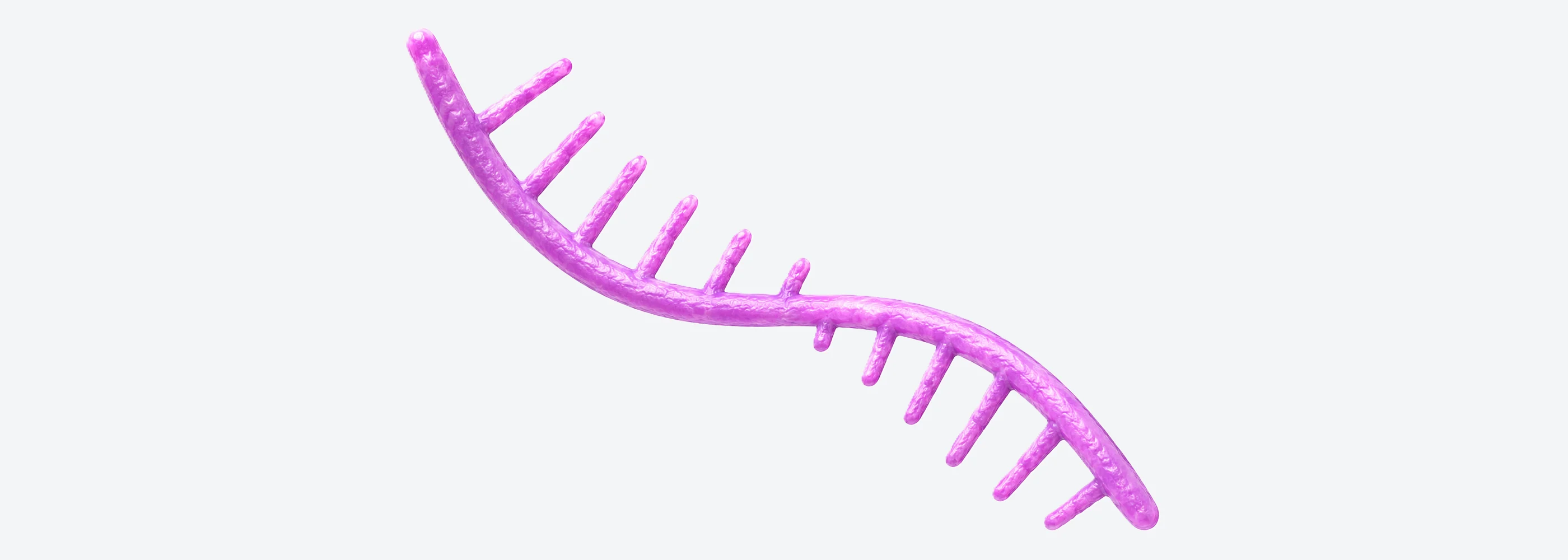
You are working with the most fragile structure in modern biology and the most valuable material on your floor at the same time. A messenger RNA transcript is a long, extended single strand, often 1,000 to 5,000 or more nucleotides, with no protective protein shell. Once encapsulated, the lipid nanoparticle that carries it is a soft vesicle that stays vulnerable until its bilayer is fully rigid. Both of these structures then spend hours recirculating through a tangential flow filtration loop, passing the pump hundreds of times. Every pass is a chance to fragment the transcript or leak the payload, and the loss is usually invisible until lot release.
This page is about where that loss actually happens in an mRNA downstream process, why it is a flow-control problem before it is a membrane problem, and how gentle, single-use equipment protects integrity and encapsulation efficiency at the steps where a lost percent is expensive and, near fill-finish, effectively unrecoverable.
Because the molecule is directly exposed to the flow path. With no protein capsid to shield it, an mRNA transcript sees hydrodynamic shear head-on. Above a threshold, shear causes chain scission that fragments the transcript, and integrity loss measured by capillary gel electrophoresis maps straight to less translatable, less potent drug substance. For mRNA-LNP, the failure mode is different but the cause is the same: shear and too-rapid buffer exchange destabilize the particle before the lipid bilayer sets, causing vesicle leakage and a drop in encapsulation efficiency.
There are two distinct filtration touchpoints, and gentle enough for one does not mean gentle enough for the other. Naked-mRNA ultrafiltration and diafiltration (UFDF) after in-vitro transcription concentrates the transcript and buffer-exchanges away residual NTPs, enzymes, double-stranded RNA and other IVT by-products. mRNA-LNP TFF after encapsulation removes ethanol, exchanges into the final cryoprotective buffer, often sucrose or trehalose, and concentrates the drug product. Each step punishes a different weakness of a different structure.
The physics that matters: harm in a TFF loop is a cumulative dose, shear per pass multiplied by number of passes. Because the retentate recirculates hundreds of times over a multi-hour step, a pump that is only a little rough on each pass still delivers a large total insult by the end. Peak shear is not the whole story; pulsation and every unstable pressure swing add to the dose.
The naked-mRNA UFDF step is capped by a squeeze between fouling and degradation. The IVT mixture is complex, the mRNA piles up at the membrane wall as concentration polarization, and the instinct is to push flux or transmembrane pressure to fight it. But pushing flux and TMP raises wall shear, which degrades the very molecule you are trying to concentrate. Fight the fouling too hard and you fragment the product; back off and throughput collapses. This is the classic yield-versus-throughput trap.
The mRNA-LNP step fails through instability. Published work shows polydispersity index rising across TFF, for example from roughly 0.05 to about 0.14, alongside a hydrodynamic-diameter shift, with guidance to keep shear rate below roughly 3,000 per second. Rapid buffer exchange and pressure swings widen that distribution and leak payload. Then, at final concentration, viscosity climbs steeply. Higher viscosity means higher shear on the product and progressively harder downstream TFF and sterile 0.2 micron filtration, exactly when the material is at its most concentrated and most valuable, risking size shift, aggregation, filter fouling and lost high-value drug product at the last step.
Two hidden killers sit under all of this. Cavitation on a starved suction side collapses vapor bubbles right at the product, and entrained air and foaming expose lipid particles and RNA to air-liquid interfaces that aggregate and destabilize them. Neither shows up on a flow meter; both show up at release.
| Process reality | What it damages | What actually protects it |
|---|---|---|
| Hundreds of recirculation passes | Transcript integrity, LNP bilayer | Lowest shear per pass, positive-displacement design |
| Multi-hour TMP swings and pulsation | Transcript, LNP, membrane; widens PDI | Near-pulseless flow, stable TMP |
| Starved suction and entrained air | LNP stability via cavitation and interfaces | Gravity-flooded suction, closed path |
| Viscosity climb at final concentration | Yield at the most valuable step | Gentle flow to 300 cP |
| Batch-to-batch changeover | Cross-contamination, cleaning burden | Fully single-use flow train |
Alphinity starts from the structure you are trying to protect and builds the flow control around it. The core insight: the recirculation pump, not the membrane, is what silently costs you mRNA integrity and LNP encapsulation efficiency, so the pump is where the engineering goes.
PIXER is a positive-displacement single-use diaphragm pump with ultra-low shear and no pinch point, so it cuts the shear delivered on every one of those hundreds of passes that fragment naked mRNA and leak LNP payload. Its multi-diaphragm harmonic cancellation produces near-pulseless flow, which holds transmembrane pressure steady across the multi-hour UFDF step and removes the pressure swings that widen polydispersity. Its gravity-flooded suction eliminates cavitation at the inlet and keeps the path from drawing air, closing off the interfacial forces that aggregate lipid particles. And because PIXER handles viscosity up to 300 cP, it stays gentle and stable at final LNP concentration, where most pumps stall or spike shear on the most valuable material.
TFFi is the purpose-built system for both touchpoints. Single-use from 30 mL to 10 L, it fits clinical and small-batch RNA volumes, and being membrane-agnostic it runs the 50 to 100 kDa cutoffs used for mRNA and LNP without forcing a membrane choice. It is driven by PIXER for stable TMP and low shear by design, is GMP-compatible, and runs on 24V DC with no compressed air, which suits closed, portable, facility-flexible RNA suites. TFFi carries the Interphex 2026 Best Technology Innovation award as external validation.
Around the membrane, the rest of the flow train is single-use too. VannX, a motorized single-use diaphragm valve with plus or minus 0.3 PSI precision on 24V DC and no compressed air, gives the fine, gentle pressure and flow control an mRNA-LNP loop needs while keeping the path closed and removing a cleaning-validation point between batches. ARTēVA single-use pinch valves, in manual, pneumatic and electric forms, and the inline single-use Buffer Dilution System complete a fully closed, disposable path. The result is that the entire flow control, not just the membrane and tubing, is single-use, so cross-contamination risk and changeover time between high-value RNA lots disappear.
The competitors sell platforms, membranes and systems, and treat the recirculation pump and the closed flow path as commodities. None makes the pump the hero. Alphinity does: gentle-by-design flow control, purpose-built for the most fragile structure in the product, protecting yield and potency at the steps where loss stays invisible until release.
A positive-displacement single-use diaphragm pump with no pinch point and near-pulseless flow delivers the least shear per pass. Because a TFF loop recirculates the retentate hundreds of times, the damaging quantity is cumulative dose, shear per pass multiplied by number of passes. PIXER uses multi-diaphragm harmonic cancellation to smooth flow and a gravity-flooded suction to keep the inlet full, so wall shear can be held in the range published guidance targets, below roughly 3,000 per second, while still moving the volume the step needs.
Run the mRNA-LNP TFF step on a single-use system that holds transmembrane pressure steady and keeps shear low so the lipid bilayer is not stressed before it is fully rigid. TFFi is membrane-agnostic, so the 50 to 100 kDa cutoffs used for LNP work drop in without forcing a membrane choice, and it is driven by the near-pulseless PIXER pump for stable TMP. Removing pressure swings and interfacial forces during ethanol removal and buffer exchange limits the polydispersity rise and hydrodynamic-diameter shift that leak payload.
Loss concentrates at two touchpoints: naked-mRNA UFDF, where concentration polarization and wall shear compete, and mRNA-LNP concentration, where shear and rapid buffer exchange destabilize the particle. Fragmentation shows up as falling integrity on capillary gel electrophoresis with recoverable mass, while fouling shows up as flux decline and rising TMP at stable integrity. Separating the two starts with stabilizing the flow: a low-shear, near-pulseless pump removes shear as a variable, so remaining loss can be attributed to the membrane rather than the transcript.
Yes. PIXER, TFFi, VannX motorized single-use diaphragm valves, ARTeVA single-use pinch valves and the inline single-use Buffer Dilution System make the whole flow train disposable, not just the membrane and tubing. The path runs on 24V DC with no compressed air, so it fits closed, portable, facility-flexible RNA suites, removes cleaning validation and eliminates cross-contamination risk and changeover time between lots.
How concentration polarization, transmembrane pressure and shear interact, and why flow stability decides your recovery.
Why positive-displacement, near-pulseless flow protects shear-sensitive molecules pass after pass.
Processing mRNA or mRNA-LNP?
Speak to an engineer