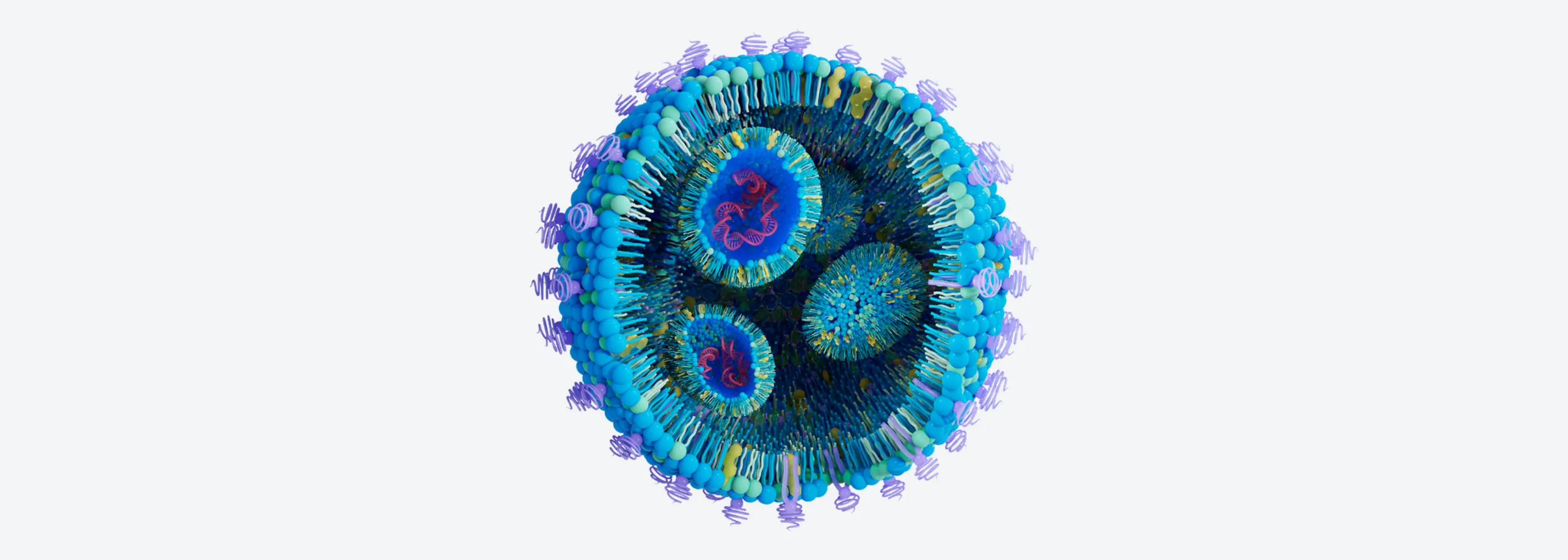
A lipid nanoparticle does not break the way a protein breaks. It is a 50 to 200 nm self-assembled lipid shell, and when it fails it fails quietly: the size distribution shifts, particles aggregate, and the encapsulated mRNA or siRNA payload leaks or is expelled. There is rarely a single catastrophic pass that does it. The damage is cumulative, the sum of shear and pressure pulsation delivered over a multi-hour tangential flow filtration loop, and the loss is often invisible on a routine yield number until it surfaces at release or in transfection performance. If you manufacture mRNA-LNP or any RNA-loaded lipid nanoparticle, the hardest part of the job is not making the particle. It is moving it through downstream processing without quietly degrading it.
Most of the industry conversation about LNP TFF is a conversation about membranes: which cassette, which molecular weight cutoff, which hollow fiber. Those choices matter. But the membrane touches each particle once per pass, while the recirculation pump acts on every particle on every one of the hundreds of passes through the loop. That makes the pump, not the membrane, the component that silently accumulates the dose that shifts size, drives aggregation and leaks payload. It is the variable most process teams have not been given a way to control.
The fragility of an LNP is mechanical, but the failure mode is a size-shift, not a rupture. Cumulative shear widens the particle size distribution and pushes a growing population above 200 nm. That has a direct downstream cost: 0.22 um sterile filtration clogs and loses yield precisely when the population carries aggregates larger than the pore, so damage done in the TFF loop is paid for at the final filter. Worse, the loss can be hard to see coming. Encapsulation efficiency assays can read high even when transfection potency, particle size and the empty-to-loaded ratio have already degraded, so the problem is detected in performance rather than on a spreadsheet.
The chemistry adds a second trap. LNPs form in 25 to 35 percent ethanol at low pH, and the ethanol has to come out. Prolonged residence at low pH during a slow TFF step drives lipid hydrolysis and hydrolipid impurity formation that compromises the bilayer, its stability and its release behavior. So a slow, gentle process and a fast, harsh process are both failure paths. You need speed and gentleness at once, which means the recirculation has to be both fast and stable. Layered on top: air-liquid interfaces, entrained air, foaming and suction-side cavitation each expose the lipid shell to interfacial and locally destructive forces that denature and aggregate particles, arguing for a closed, air-free, flooded-suction flow path.
The dose is cumulative. An LNP does not fail on one bad pass. Shear and pulsation add up across every recirculation pass in a multi-hour loop. As the industry moves from hours-long batch TFF toward longer semi-continuous and continuous runs under ICH Q13, the number of passes multiplies and the cumulative dose on a fragile particle rises with it. Lowering the per-pass dose is the leverage point.
The riskiest ground is concentration and UFDF: ethanol removal and diafiltration into a physiological buffer such as PBS. This is where potency is silently lost. Shear damages the lipid shell, concentration polarization at the membrane wall drives local aggregation and fouling, and permeate flux declines as blocked pores accumulate. Then, as you push toward final drug-product strength, typically 0.5 to 5 mg/mL, viscosity rises. Higher viscosity increases shear on the particles and can stall or destabilize a pump that was never designed for viscous feeds, exactly at the concentration step where the product is most valuable and least replaceable.
These high-value, small-batch, often personalized RNA products also raise the stakes on cleaning and changeover. Cleaning validation between batches is risky and slow, which pushes the entire flow path, not just the membrane and tubing, toward fully single-use: pump head, valves, manifold and membrane. The table below maps each failure mode to where it originates and where it is paid for.
| Failure mode | Where it originates | Where you pay for it |
|---|---|---|
| Size shift and aggregation >200 nm | Cumulative pump shear and pulsation across passes | 0.22 um sterile filter clogs, yield lost |
| Payload leakage / potency drop | Shear on the lipid shell over the full loop | Failed release or weak transfection |
| Lipid hydrolysis / hydrolipids | Prolonged low-pH residence in a slow ethanol strip | Compromised bilayer, stability and release |
| Local aggregation and fouling | Concentration polarization at the membrane wall | Declining flux, longer runs, more dose |
| Interfacial denaturation | Air-liquid interfaces, foaming, cavitation | Aggregates that later blind the filter |
| Cross-contamination risk | Reused pump heads, valves and manifold | Cleaning validation burden, changeover delay |
The common thread is the flow path. See how tangential flow filtration works and how pump architecture governs shear for the underlying physics.
Alphinity builds TFF from the recirculation pump up, because on a fragile particle the pump is the variable that quietly determines the outcome. TFFi is single-use tangential flow filtration for concentration, buffer exchange and formulation, spanning 30 mL to 10 L. That range covers the two riskiest LNP unit operations, ethanol-removal diafiltration and final concentration, and it spans process development through GMP clinical batches without changing the shear environment the particles see on scale-up. TFFi is GMP-compatible, runs on 24V DC with no compressed air, and is membrane-agnostic, so LNP developers keep their validated membrane chemistry and cutoff, such as the 100 kDa cassettes commonly used for RNA and LNP, and gain gentle, pump-driven flow rather than being forced into a membrane switch. TFFi won the Interphex 2026 Best Technology Innovation award.
The engine is the PIXER pump, a positive-displacement single-use diaphragm pump built for exactly this failure mode. Its ultra-low shear and near-pulseless flow cut the cumulative shear dose delivered on every recirculation pass, which is what shifts LNP size, drives aggregation and leaks payload. Multi-diaphragm harmonic cancellation produces near-continuous flow, protecting the lipid shell from the pulsation that is especially damaging to lipid particles, and letting the process run fast enough to avoid prolonged low-pH lipid hydrolysis while staying gentle. Its gravity-flooded suction eliminates cavitation at the inlet, removing a hidden source of aggregate generation that would later clog the sterile filter. And because PIXER handles viscosity up to 300 cP, it holds stable flow as LNPs concentrate toward final drug-product strength, where a pump not built for viscous feeds would stall or spike shear.
Fast and gentle at the same time. Stable, near-pulseless flow holds transmembrane pressure steady, so you can drive ethanol removal and diafiltration at pace without the pressure swings that stress particles and membrane. That resolves the LNP dilemma: gentle enough to protect the shell, fast enough to keep low-pH residence short.
Around the pump, the rest of the flow path is single-use and closed. The TFFi and PIXER single-use head and check valves, together with VannX and ARTēVA single-use valves and the single-use Buffer Dilution System, deliver an end-to-end closed, air-free system. That removes cleaning validation and cross-contamination risk between high-value RNA batches and eliminates the air-liquid interfaces that denature and aggregate particles. VannX is a motorized single-use diaphragm valve with plus or minus 0.3 PSI precision and electric 24V DC actuation, giving the precise, gentle pressure control a UFDF loop needs, with no compressed air anywhere in the platform to simplify closed-system deployment in cleanroom and fill-finish-adjacent settings. The Buffer Dilution System provides inline, closed, single-use management of the diafiltration buffer used to strip ethanol and exchange into the final formulation buffer, keeping that critical step contamination-controlled.
The competitive landscape leads with membranes, formulation instruments, cassettes, hollow fiber and analytics, and the standard advice for shear-sensitive product is to run conventional TFF slower and gentler. That treats the recirculation pump as a given. Alphinity does not. The recirculation pump is the variable silently determining LNP yield and potency, and building the platform from a purpose-built ultra-low-shear, near-pulseless, gravity-flooded, fully single-use pump lets particles hold their size, encapsulation and payload across hundreds of passes rather than asking developers to slow down and hope.
Encapsulation efficiency can read high while transfection potency, particle size and the empty-to-loaded ratio have already degraded, so a routine yield number can hide the loss until release testing. Shear damage shows up as a widening size distribution, a rising population above 200 nm and payload leakage that tracks with cumulative recirculation passes, worsening the longer the loop runs. A membrane problem shows up as declining permeate flux and rising fouling largely independent of pass count. Trend particle size and polydispersity against total passes and against transmembrane pressure. If size drifts with pass count while flux holds, the pump is delivering the damage, not the membrane.
The membrane is contacted once per pass, but the pump acts on every particle on every one of the hundreds of passes through the loop, so pump-delivered shear and pulsation accumulate into the dominant dose the particles see. A positive-displacement single-use diaphragm pump such as PIXER, with multi-diaphragm harmonic cancellation for near-pulseless flow and gravity-flooded suction that eliminates cavitation, minimizes that per-pass dose. Lowering the shear and pressure swings the pump imposes protects size, encapsulation and payload more directly than changing membrane chemistry, which is why the pump is the variable to fix first.
LNPs form in 25 to 35 percent ethanol at low pH, and prolonged residence at low pH drives lipid hydrolysis and hydrolipid impurities that compromise the bilayer, so a slow gentle process and a fast harsh process are both failure paths. The resolution is fast plus gentle at the same time: a near-pulseless pump holding stable transmembrane pressure lets you drive diafiltration at pace without the pressure spikes and pulsation that damage particles, shortening low-pH residence. A closed, inline single-use Buffer Dilution System delivers the exchange buffer under control so the ethanol strip and formulation exchange stay contamination-controlled.
Aggregates above 200 nm are made upstream, by shear, pulsation, cavitation and air-liquid interfaces in the TFF loop, and they arrive at the 0.22 um sterile filter as clogging load and lost yield. Preventing them means attacking their sources in the flow path: run an ultra-low-shear, near-pulseless pump, use gravity-flooded suction to eliminate cavitation, and keep the path closed and air-free to remove the interfaces that denature and aggregate the lipid shell. Cleaner particles reaching the final filter mean the sterile step passes more of the batch through instead of blinding on aggregates.
How UF/DF works, why concentration polarization limits flux, and how to run gentle buffer exchange on shear-sensitive product.
How positive-displacement, low-pulsation and flooded-suction design lower the cumulative shear dose on fragile particles.
Processing lipid nanoparticles?
Speak to an engineer