A pinch valve controls flow by compressing a length of flexible tubing from the outside. Nothing in the valve mechanism ever touches the product, only the tubing does. That makes it the simplest sterile flow control there is, and the reason it appears throughout single-use bioprocessing. The same mechanism also sets clear limits on precision and on how long the tubing lasts.
What is a pinch valve?
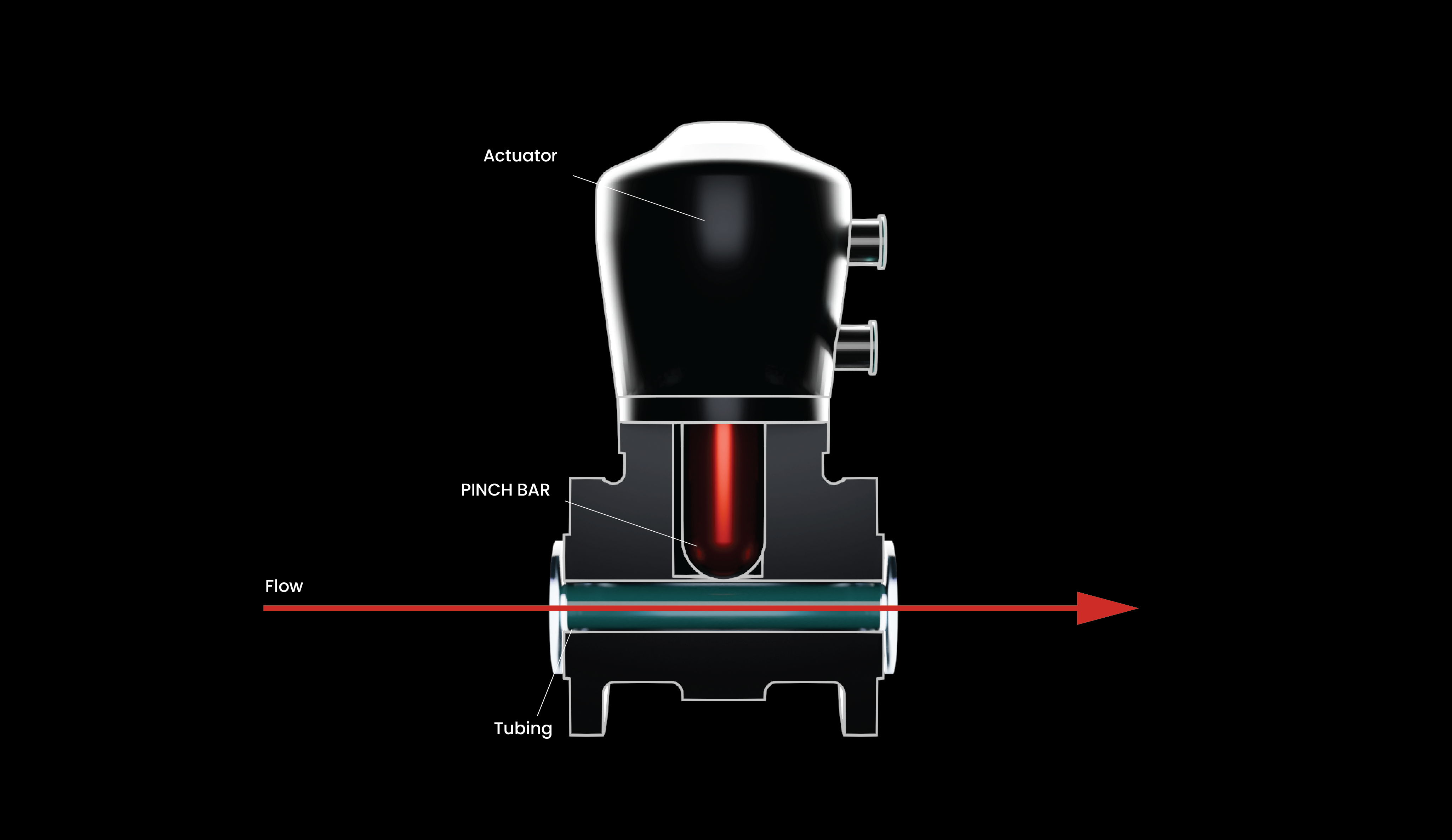
A pinch valve is, at its simplest, an actuator and a piece of flexible tubing. The tubing carries the fluid; the actuator squeezes it from the outside to throttle or stop the flow. There is no valve seat, no diaphragm, and no body bore in contact with the product. The wetted path is the inside of the tubing and nothing else.
Pinch valves are actuated manually, pneumatically, or electrically depending on the duty. Alphinity's ARTeVA series covers all three, for single-use flow paths from the bench to production.
How does it close?
To close, the actuator drives a bar or plunger down onto the tubing, compressing it against a fixed jaw on the other side. As the walls of the tubing are pushed together, the bore shrinks and the flow throttles down. When the walls meet, the bore is fully occluded and flow stops completely. Release the bar and the tubing's own elasticity reopens the bore.
The seal, in other words, is made by the tubing pressing against itself, not against a metal or polymer seat. That is what keeps the mechanism so clean: the only thing that ever closes on the fluid is the fluid's own tubing.
Why is it suited to single-use?
Because the tubing is the only wetted component, a pinch valve inherits all the advantages of single-use directly. There is no body to clean, no seat to validate, and no cross-contamination path between batches. Fit a fresh tubing assembly and the flow path is renewed; the actuator is reused without ever having touched the product.
It is also forgiving and visible: an operator can see the tubing open and close, and there is very little to go wrong mechanically. For simple isolation duty in a single-use manifold, few things are simpler or more robust.
The tubing is the valve specification
The single most important point about a pinch valve is that the tubing defines the valve. The same actuator behaves completely differently depending on what it is pinching. Four tubing parameters set the behavior:
| Tubing parameter | Why it matters |
|---|---|
| Inner diameter (ID) | Sets the flow area and the maximum flow at a given pressure |
| Wall thickness | Determines the force needed to occlude and how cleanly the bore reopens |
| Outer diameter (OD) | Must match the valve jaw geometry for a complete, repeatable pinch |
| Material and hardness (durometer) | Drives sealing force, fatigue life, and how far the tubing creeps over time |
This is why a pinch valve inquiry should always start with the tubing, not the valve. A request for a "one inch" pinch valve means little until the tube ID, OD, wall, and material are known, because those are what the valve has to be matched to.
What are the trade-offs?
The mechanism that makes pinch valves so clean also bounds what they can do.
Proportional control is limited. The relationship between bar position and flow is non-linear, and the tubing's elasticity makes fine, repeatable throttling harder than with a diaphragm valve under a precise actuator. Pinch valves are at their best in on/off and coarse-throttle duty.
The tubing fatigues. Every close cycle flexes and compresses the tubing. Over many cycles it can take a set, creep, or eventually fail, so tubing life is a real design parameter, not an afterthought, particularly in high-cycle or long-campaign service.
Sealing depends on consistent tubing. Because the tube seals against itself, variation in tubing dimensions or hardness shows up directly as variation in closing force and seal integrity. Consistent, qualified tubing matters as much as the valve.
Where these trade-offs decide the choice, the diaphragm valve vs pinch valve guide works through it position by position.
Where do pinch valves belong?
Pinch valves are a strong fit for single-use tubing manifolds, isolation and on/off duty, media and buffer lines, and any application where keeping the product path simple and disposable matters more than fine modulation. They scale comfortably from lab benches to production skids.
Where the process needs precise, repeatable pressure or flow control, a diaphragm valve under an electric actuator is usually the better tool. See How Diaphragm Valves Work for that comparison, and Types of Valves in Bioprocessing for the full picture.
A pinch valve is only as good as the tubing it pinches. Specify the tubing, ID, wall, OD, and durometer, and you have specified the valve. Specify the valve alone, and you have specified almost nothing.
Where to read next
Types of Valves in Bioprocessing
The full comparison across diaphragm, pinch, check, and ball or butterfly. Read →
How Diaphragm Valves Work
The valve to reach for when you need precise, repeatable control. Read →
Pneumatic vs Electric: What the Spec Sheet Doesn't Tell You
How the actuator decides response, precision, and feedback. Read
Pump Types in Bioprocessing
The companion fundamentals on the pump side. Read →
Common questions
How does a pinch valve work?
An external mechanism, motor-driven or pneumatic, compresses a length of flexible tubing from the outside until the tube wall closes against itself and blocks flow. Releasing the compression lets the tube recover and re-open. The fluid contacts only the tubing bore; the valve body never touches the product.
What are the advantages of pinch valves in single-use bioprocessing?
The wetted path is just the tubing, which is already disposable, so there is no valve body to clean, qualify, or worry about for cross-batch contamination. Hold-up is essentially zero. The actuator can be reused across batches because it never sees the fluid, which keeps single-use costs low.
What limits the precision of pinch valves?
Tubing wall thickness and durometer set how reproducible the close is, and both drift with cycles as the tubing fatigues. Compression varies with temperature and creep. For coarse on/off duty this is fine; for fine modulating control, a diaphragm valve with encoder-based actuation holds a tighter pressure band.
The anchor comparison: the four valve types, the actuation choice that matters more than the type, and where each belongs.
Standards & further reading
- ASME BPE (Bioprocessing Equipment). The standard for single-use and hygienic component design, including tubing and product-contact materials.
- USP <88> / Class VI and USP <665>. Biocompatibility and plastic-component references relevant to tubing selection in product-contact service.