Every positive-displacement diaphragm delivers flow during part of its cycle and nothing during the rest. Run one alone and the discharge is a series of pulses. Combine several, phased evenly around the drive, and the pulses overlap into a steadier stream. How steady depends entirely on the number and the symmetry of the diaphragms, and you can prove it without a test rig.
Where the ripple comes from
A pump is a sum of phased sources
Take a pump with N diaphragms spaced evenly, each phased 360 degrees / N apart. Each one produces the same flow profile q over a cycle, just shifted in time. The delivered flow is the sum of all of them:
Decompose a single diaphragm's pulse into its harmonics. The interesting question is which of those harmonics survive once you add all N copies together.
The cancellation rule
Only multiples of N survive
For harmonic number k, summing the phase-shifted copies gives a geometric sum that has a clean answer:
= 0 otherwise
So every harmonic cancels except those at integer multiples of N. A pump with N diaphragms has its first ripple harmonic at order N, the next at 2N, and so on. Because a single diaphragm's higher harmonics are weaker than its lower ones, pushing the first surviving ripple to a higher order means a smaller residual. More diaphragms, less pulsation. A five puts its first ripple at the fifth order where a four puts it at the fourth, and the seventh is quieter still.
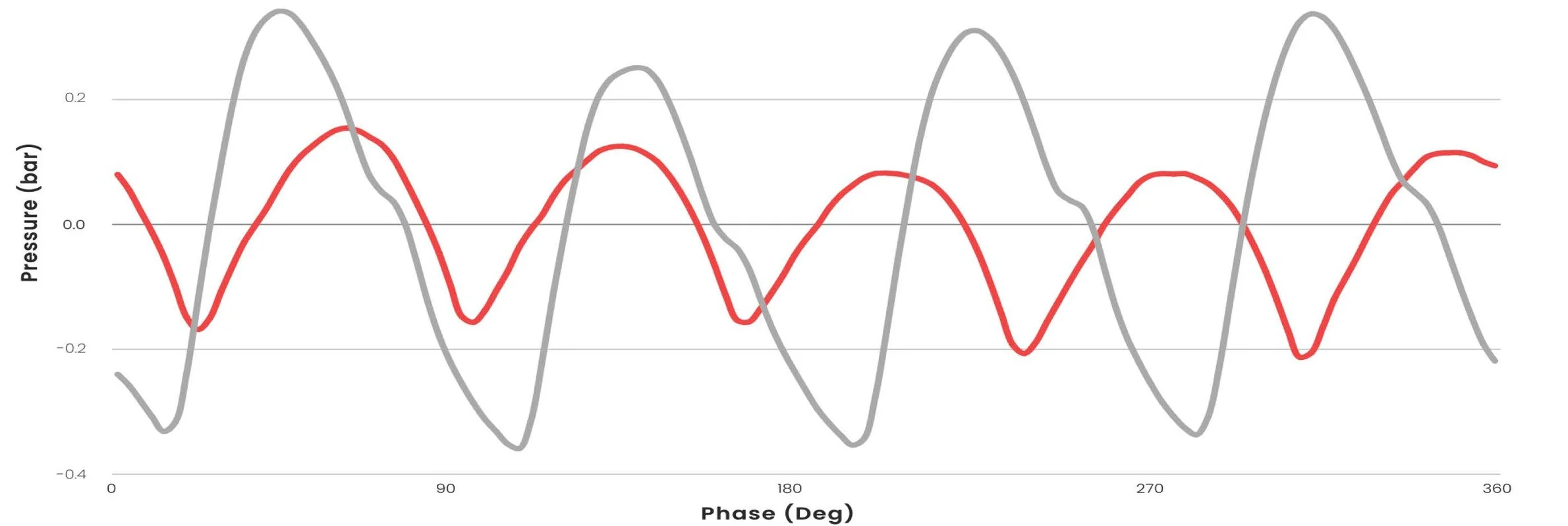
Why odd beats even at the same count
The flaw is the symmetry, not the count
Count is not the whole story, because parity changes the spectrum. With an even N the diaphragms fall into directly opposed pairs, 180 degrees apart. A pulse and its 180-degree replica add constructively at the even harmonics and cancel at the odd ones, so an even-count pump carries a stubborn, reinforced even-order component down low in the spectrum, exactly where it is hardest to damp. Four-diaphragm designs, often called quaternary diaphragm pumps, are the most familiar even-count architecture in bioprocessing. Because their chambers fire in symmetric pairs, their pressure pulses reinforce at even harmonics instead of canceling. With an odd N no two diaphragms are ever opposed; the even orders cancel, and the residual lives only at the Nth order and above, where amplitudes are small and a modest dampener can finish the job. That is why a five runs smoother than a four, and a seven smoother than a five.
Why tuning cannot save an even design
You cannot damp away a geometric ripple
The residual ripple of an even-count pump is not a calibration error. It is a property of the geometry, fixed the moment the diaphragm count and phasing are chosen. A pulsation dampener can attenuate it, but a dampener is a compliance volume: it adds hold-up, introduces lag into the control loop, and treats the symptom while the source keeps generating the same reinforced harmonic. The honest fix is upstream, in the arrangement, which is why the smoothest passive geometry is an odd, radially phased one.
Common questions
Why do odd-numbered diaphragm pumps have less pulsation?
With an odd number of diaphragms, no two sit in direct opposition, so the even-order harmonics cancel and only ripple at the Nth order and above survives the phased summation. Even-numbered designs place diaphragms in opposed pairs that reinforce a low even-order component, which is harder to damp. The smoothness comes from breaking symmetry, not simply from adding heads.
Is a pump with more diaphragms always smoother?
As a rule yes, because the first ripple harmonic sits at the diaphragm count N, so a higher N pushes ripple to a higher, weaker order. Parity adds to this: at a given count, an odd layout cancels the reinforced even-order component an even layout retains. So a five is smoother than a four and a seven smoother than a five.
Can a pulsation dampener fix an even-count pump?
It can attenuate the ripple but not remove its source. A dampener is a compliance volume that adds hold-up and control-loop lag while the geometry keeps generating the same reinforced harmonic. The residual is set by the arrangement, so the durable fix is the diaphragm count and symmetry, not downstream tuning.
What to read next
The biology didn't change and the membrane didn't change. The mechanical environment did, and pulsation is one of the variables that moved.
Positive displacement without tubing contact. Single, quaternary, and radial configurations, and what is different about each.
Shear, cavitation, pulsation, or hold-up? A symptom-to-mechanism framework for finding the real cause of yield or potency loss.