A diaphragm valve controls flow by pressing a flexible membrane against a weir or seat inside the valve body. The actuator never touches the product, the diaphragm is the only moving wetted surface. That separation is why it is the default valve in single-use and hygienic bioprocessing, and the actuation behind it is what decides whether it can hold a precise setpoint or merely open and close.
What is a diaphragm valve?
A diaphragm valve has three functional parts: a body with the flow path, a flexible diaphragm, and an actuator (the part that moves the diaphragm). The diaphragm is clamped across the body so that the product flows underneath it and the actuator presses on top of it. Because the diaphragm seals the product space off completely, nothing above it (the stem, spring, or motor) ever contacts the fluid.
That single feature, total isolation of the product from the working parts, is what makes the diaphragm valve the workhorse of hygienic and single-use processing. The wetted path is just the body bore and the underside of the diaphragm, both of which are smooth, drainable, and easy to sterilize.
How does it seal?
When the actuator drives the diaphragm down, the membrane is pressed against a raised ridge in the body called the weir. Contact across the full width of the weir closes the flow path. Lifting the actuator releases the diaphragm, and process pressure (or the diaphragm's own elasticity) opens the path again.
The quality of that seal depends on even compression across the weir. Too little and it leaks; too much and the diaphragm fatigues faster. This is why the diaphragm is a consumable item with a defined cycle life, and why the actuator's job is not just "open or shut" but applying a controlled, repeatable closing force.
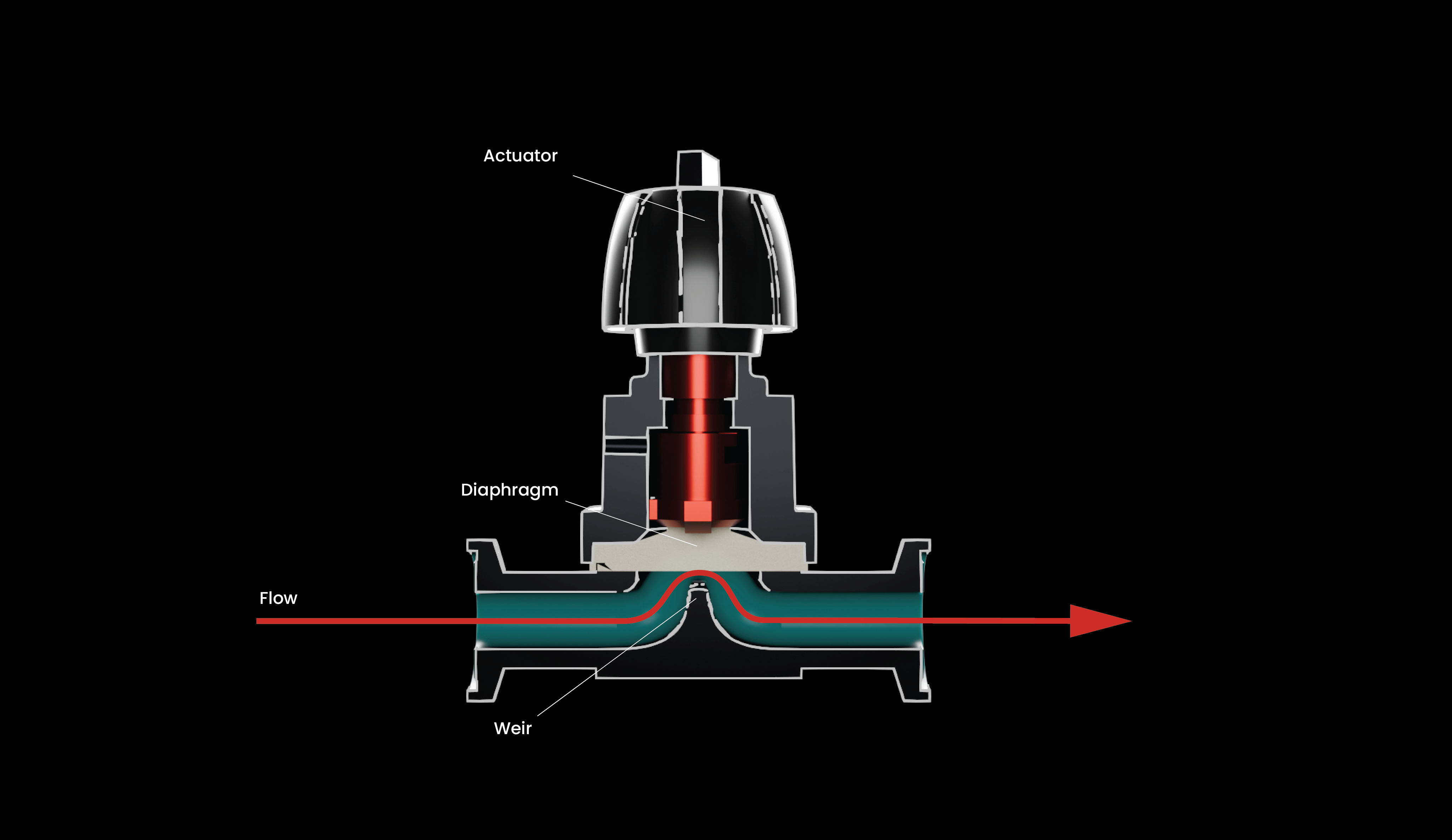
Weir type vs full-bore
Most hygienic diaphragm valves are weir type: the raised weir gives a clean, self-draining seal and a short diaphragm stroke, which is ideal for clean fluids, buffers, media, and product. A smaller number are straight-through (full-bore) designs, where the diaphragm closes onto the floor of a full-bore body. Full-bore handles slurries and particulates better but is less common in clean bioprocessing because the geometry is harder to drain.
For single-use bioprocessing, weir-type diaphragm valves are effectively the standard, and they are the basis of most single-use manifold designs.
What determines control resolution?
A diaphragm valve can do far more than open and close. With the right actuator it can hold any intermediate position to throttle flow or regulate pressure. Whether it actually achieves that, and how precisely, is set almost entirely by the actuator, not the valve body.
A pneumatic actuator pressurizes an air volume to move the diaphragm. It is typically used for open/close duty, with position inferred rather than measured. An electric actuator (a stepper motor with encoder feedback) positions the diaphragm in fine increments through microstepping, knows its exact position at all times, and can hold a pressure setpoint within a tight band. The same diaphragm valve body delivers very different control depending on which sits on top of it.
This is the principle behind modern electric diaphragm valves: they hold pressure to roughly plus or minus 0.3 PSI with encoder feedback and no compressed air. The mechanism is the same diaphragm-on-weir seal described above; the precision comes from the actuation. For the full comparison, see Types of Valves in Bioprocessing.
Why does diaphragm material matter?
The diaphragm is the one part that both seals the valve and wears out, so its material is specified to the process rather than chosen by default. The common choices trade off differently:
| Material | Strengths | Watch for |
|---|---|---|
| EPDM | Good elasticity and cycle life, broad chemical compatibility, lower cost | Limited resistance to some solvents and oils |
| PTFE (usually backed by EPDM) | Excellent chemical resistance and low extractables, wide temperature range | Stiffer, shorter flex life, higher cost |
| TPE / other elastomers | Tunable properties for single-use, often used in molded assemblies | Compatibility and life vary by formulation |
For bioprocessing, the material decision is also a compliance decision: the diaphragm is a wetted, product-contact component, so its USP Class VI status, extractables profile, and animal-derived-component-free declaration all matter as much as its mechanical life.
A diaphragm valve is only as good as the two things you cannot see on a photo of it: the diaphragm material and the actuator behind it. The body is rarely the variable. Specify those two to the process, and the valve follows.
Where do diaphragm valves belong?
Diaphragm valves are the default choice for clean, hygienic, and single-use fluid paths: buffer and media handling, product transfer, and any duty needing precise, repeatable flow or pressure control. With an electric actuator they are particularly suited to closed-loop pressure control, including TFF retentate and permeate regulation, where holding a stable setpoint directly protects flux and yield.
They are less suited to large-bore, high-flow on/off duty in stainless systems, where ball or butterfly valves are more economical, and to fluids with heavy particulates, where a full-bore body or a different valve type fits better.
Where to read next
Types of Valves in Bioprocessing
The full comparison across diaphragm, pinch, check, and ball or butterfly. Read →
How Pinch Valves Work
External compression on flexible tubing, and where it fits versus a diaphragm valve. Read
Pneumatic vs Electric: What the Spec Sheet Doesn't Tell You
Why the actuator decides control resolution, response, and feedback. Read
Diaphragm Valve or Pinch Valve?
Choosing position by position in closed single-use systems: diaphragm valve vs pinch valve.
What is TFF?
Where diaphragm valves regulate pressure in a filtration loop. Read →
Common questions
How does a diaphragm valve work?
A flexible elastomeric diaphragm is pressed by an actuator stem against a weir or seat inside the valve body. Closing the actuator deflects the diaphragm onto the weir to block flow; opening lifts it off. Only the diaphragm contacts the fluid, so the wetted path stays smooth, drainable, and cleanable.
What materials are used for diaphragms in bioprocessing valves?
EPDM, PTFE, and TPE are the common elastomers. EPDM is the broadly compatible default for aqueous biologics; PTFE handles aggressive chemicals and high temperature with lower flex life; TPE is a single-use alternative tuned for cycle life. Material is matched to the process chemistry, temperature, and required cycle count.
Why are diaphragm valves common in single-use bioprocessing?
They isolate the fluid from the actuator, so the wetted path is just the diaphragm and the body interior. The geometry has no dead legs to harbor product, drains and cleans cleanly, and the same valve body supports either on/off isolation or precise modulation depending on the actuator on top of it.
The anchor comparison: the four valve types, the actuation choice that matters more than the type, and where each belongs.
Standards & further reading
- ASME BPE (Bioprocessing Equipment). The standard governing hygienic valve design, weir geometry, surface finish, drainability, and material documentation for product-contact components.
- USP <88> / Class VI and USP <665>. The biocompatibility and plastic-component references relevant to diaphragm material selection in product-contact service.