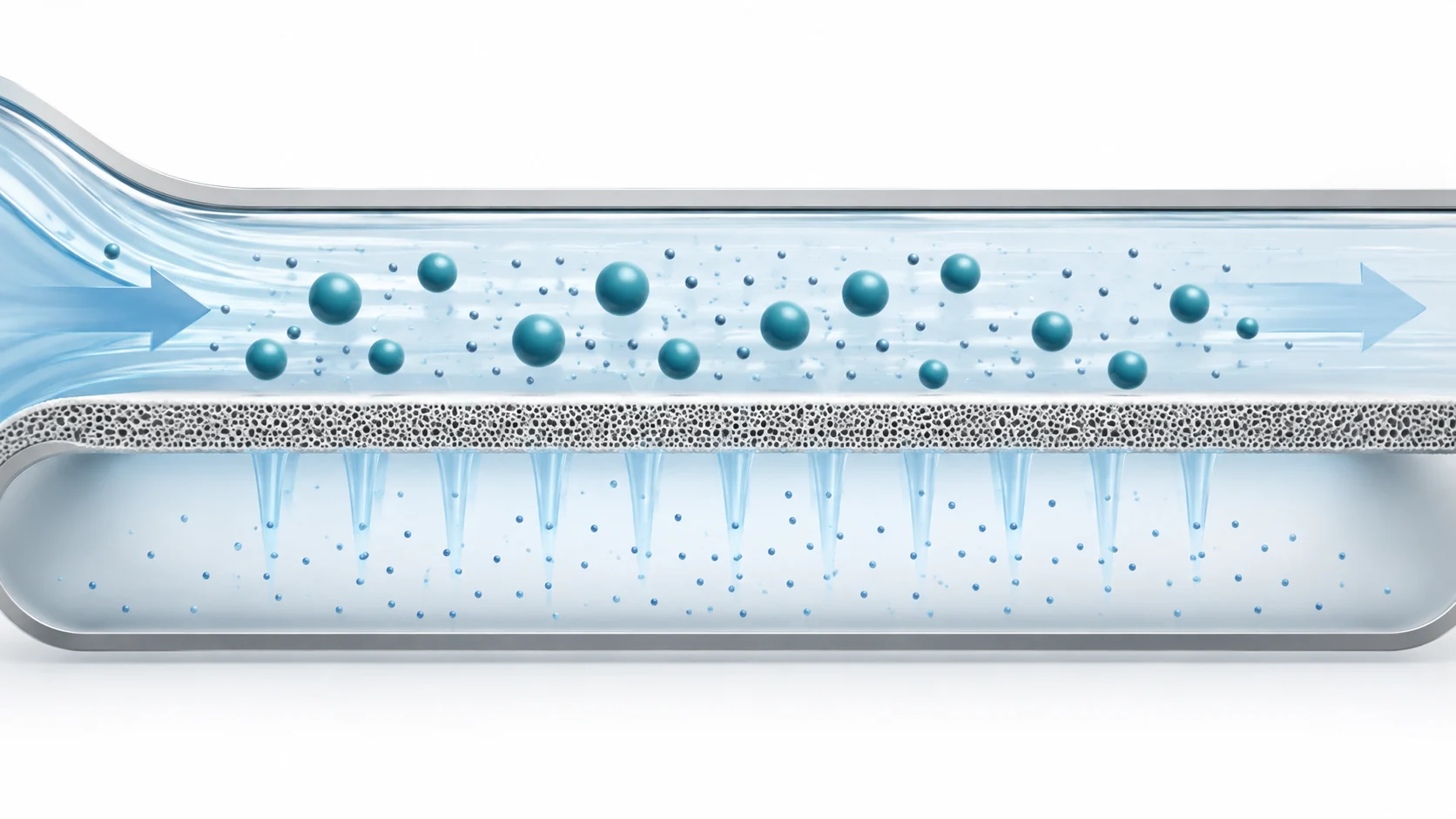
The membrane does the separation, but it is usually the last thing specified and the first thing blamed. Matching chemistry, cutoff, and format to the actual duty is what makes a tangential flow filtration step behave.
Ask most teams why a concentration step is running slow, giving poor recovery, or fouling halfway through, and the conversation starts at pressure, crossflow, and flux. The membrane itself often gets pulled off a shelf because it was what the last process used. That is where a lot of avoidable trouble begins. A membrane has three properties worth deciding on purpose: what it is made of, what it lets through, and how it is packaged. Get those right for the specific job and the operating window opens up. Get them wrong and no amount of parameter tuning fully rescues it.
Two materials cover most bioprocess work, polyethersulfone (PES) and regenerated cellulose (RC), and they behave differently in ways that matter.
PES is tough. It handles a wide pH and cleaning range, gives high flux, and shrugs off aggressive sanitization. Its weakness is that bare PES is fairly hydrophobic, so proteins and other sticky molecules adsorb onto it. That adsorption shows up as fouling, as flux decay, and sometimes as product you never get back. Most commercial PES made for TFF is surface-modified to be more hydrophilic for exactly this reason, and it is worth knowing whether the grade in front of you is modified or bare.
Regenerated cellulose is the low-binding option. It fouls less with proteins, holds flux better through a long diafiltration, and tends to recover more because less product sticks to it. The trade is robustness. Historically RC was fussier about caustic and oxidizers, and while modern composite cellulose is far more forgiving, it still generally tolerates a narrower cleaning and storage window than PES.
The short version. If the molecule is sticky, or recovery is the number you are judged on, lean cellulose. If you need chemical ruggedness, high throughput, and repeated harsh cleaning across campaigns, PES earns its place. Neither is a default. The feed decides.
Molecular weight cutoff is the number everyone quotes and the one most often misread. A 30 kDa membrane does not put a clean wall at 30 kDa. MWCO is a nominal rating, usually the size at which the membrane retains around 90 percent of a marker solute, and real molecules are not neat spheres. Shape, charge, and process conditions all move the effective cutoff around.
What the nominal figure does give you is a reliable rule of thumb, and it is worth committing to memory, because it settles most selection decisions in seconds.
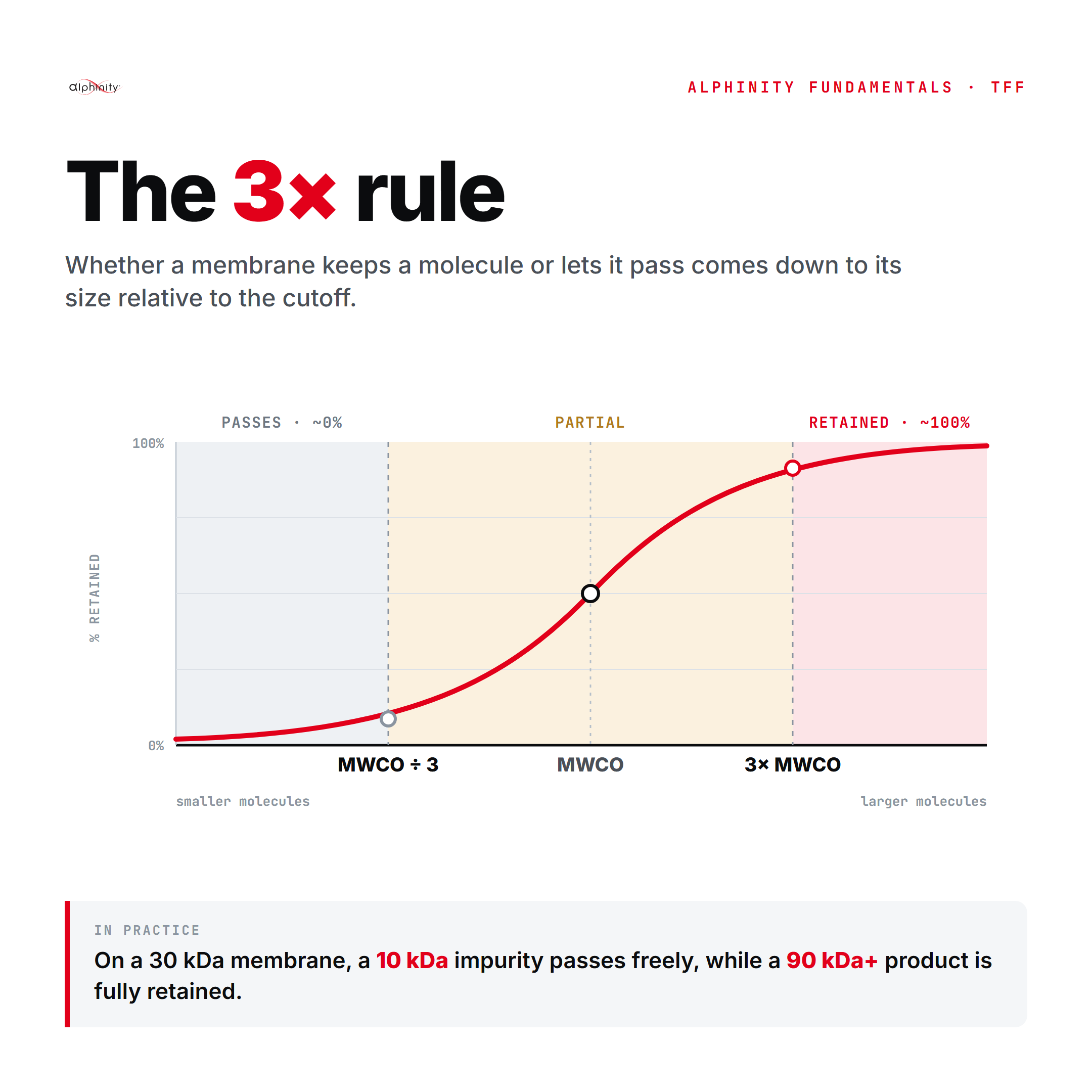
Larger than 3x the MWCO: fully retained (~100%). A 30 kDa membrane holds anything from roughly 90 kDa upward with negligible passage, which is why a 150 kDa antibody on a 30 kDa membrane, a 5x margin, sits there comfortably.
Smaller than the MWCO divided by 3: passes freely (~0% retained). On that same 30 kDa membrane, a 10 kDa impurity clears straight into the permeate.
Within 3x either side: partial. And if the thing you want to keep and the thing you want to remove both land in that band, no membrane separates them cleanly. A clean separation needs the product and the impurity on opposite sides of the margin.
That is why cutoff selection is really about the gap between the product and whatever you are trying to remove, not the product alone. If the impurities you are clearing are small, salts and buffer components and small peptides, the goal is not a tighter membrane, it is one that passes those freely while holding the product. Get both species on the right sides of the 3x margins and the separation almost designs itself.
Large modalities flip the intuition. An AAV capsid is several megadaltons, so retention is trivial and the interesting question is how open you can go to pass host cell protein and free DNA while keeping the capsids. Membranes rated in the hundreds of kilodaltons, 300 kDa and beyond, come into play. Same rule, match the cutoff to the separation you actually need, not to a habit.
The same chemistry can arrive in two very different packages, and the package changes how the step behaves as much as the polymer does.
Flat-sheet cassettes pack a lot of area into a small footprint and use a screened feed channel that promotes turbulence, which lifts mass transfer and flux. That efficiency is why cassettes dominate high-area protein processing. The costs are shear and sensitivity to solids. The screen that helps flux also imposes higher shear on the feed and clogs if that feed carries particulates, so cassettes want a clean, prefiltered stream.
Hollow fiber runs an open lumen with no screen. Feed flows straight down the inside of the fibers, which means low, predictable shear and a genuine tolerance for solids and higher viscosity. That is why hollow fiber is the usual pick for cells, for many viral vectors, and for anything fragile enough that a screen would damage it. The trade is area density and pressure tolerance. Hollow fiber gives less membrane area per unit volume, so it needs more footprint for the same duty, and fibers do not enjoy being over-pressured or backpressured.
Hold-up volume sits underneath both choices and gets ignored until it bites. Every bit of internal volume the product cannot be flushed out of is product lost. For a 200 liter protein pool that is a rounding error. For a few hundred milliliters of viral vector it can be the line between a viable batch and a failed one, which is why minimum working volume and recoverability deserve as much scrutiny as flux for small, high-value feeds.
| Feature | Hollow fiber | Flat sheet cassette |
|---|---|---|
| Construction | A bundle of porous tubes; feed flows through the open fiber lumen | Stacked membrane sheets separated by screened flow channels |
| Flow channel | Open lumen with no feed screen | Feed screens create turbulence at the membrane surface |
| Shear at a given crossflow | Lower | Higher |
| Mass transfer and flux per area | Lower | Higher |
| Operating pressure | Usually lower TMP limits | Usually higher TMP limits |
| Typical fit | Shear-sensitive products, viral vectors, larger particles, perfusion | Proteins and mAbs, high-concentration formulation |
| Scale-up | Longer fibers or larger modules | Add cassettes in parallel |
Neither format is better in general. The choice depends on how shear-sensitive the product is and how hard the step has to concentrate it.
Put the three decisions together and a pattern shows up. Start from the feed and the job, not the catalog.
A monoclonal antibody being concentrated and buffer-exchanged at scale is classic cassette territory: modified PES or cellulose, a cutoff well under 150 kDa, screened channels for flux, a clean prefiltered feed. A shear-sensitive cell suspension for perfusion or harvest points the other way, toward hollow fiber, an open channel, and a selection driven by gentleness and solids tolerance rather than raw area. A viral vector concentration in a small volume brings recovery and hold-up to the front of the queue, often hollow fiber, a fairly open cutoff to clear impurities, and a hard look at how far down the whole flow path can be run.
None of this is exotic. It is the discipline of choosing on purpose.
One more thing, because it is the failure mode that gets misattributed most often. A well-chosen membrane can still be let down by what pushes fluid across it. Harsh pump shear damages the very cells and vectors the membrane was selected to protect, and pulsation cycles the transmembrane pressure so the sieving behavior you validated at the bench is not the behavior you get on the floor. A membrane is only as good as the fluid path around it. That is the reason Alphinity builds systems like TFFi around low-shear, all-electric flow control, so the separation designed at the bench is the one that runs at scale.
PES is chemically rugged and high-flux but binds proteins more, so it can foul and lose product unless it is surface-modified. Regenerated cellulose binds less, fouls less, and usually recovers more, but tolerates a narrower range of cleaning chemistries. Choose cellulose when recovery and low fouling matter most, and PES when you need chemical robustness and high throughput.
Use the 3x rule. Anything larger than three times the MWCO is effectively fully retained, and anything smaller than the MWCO divided by three passes freely. Pick a cutoff that puts your product above the upper margin and the impurities you are removing below the lower one. If both sit within 3x of the cutoff, no membrane will separate them cleanly.
No. MWCO is a nominal rating, typically the size at which the membrane retains about 90 percent of a marker solute. Molecules vary in shape and charge, so the effective cutoff shifts with the product and the conditions. Use the 3x margins as your working guide, then confirm retention with your actual material.
Use hollow fiber for shear-sensitive feeds such as cells and many viral vectors, and for feeds with solids or higher viscosity, because the open channel is gentle and tolerant. Use cassettes when you need high membrane area in a small footprint and high flux, with a clean prefiltered feed.
Hold-up is the volume trapped in the system that cannot be recovered, so it is product lost. It is negligible for large feeds, but for small, high-value batches like viral vectors it can decide whether a batch is viable, which makes low hold-up and recoverable formats important for those duties.
No. The pump and valves that move fluid across the membrane matter as much. Excess shear can damage fragile products, and pulsation destabilizes transmembrane pressure, so even a well-chosen membrane needs a low-shear, stable fluid path to perform as designed.
Where mechanical damage comes from in TFF, why recirculation multiplies it, and how to protect fragile product.
Why permeate flux plateaus regardless of pressure, and what the polarization layer is doing at the membrane surface.
Reagent-by-reagent compatibility for TPV, EPDM, and polypropylene, the materials in Alphinity's single-use flow path.
Specifying a membrane and want a second opinion on the pump path around it?
Speak to an engineer