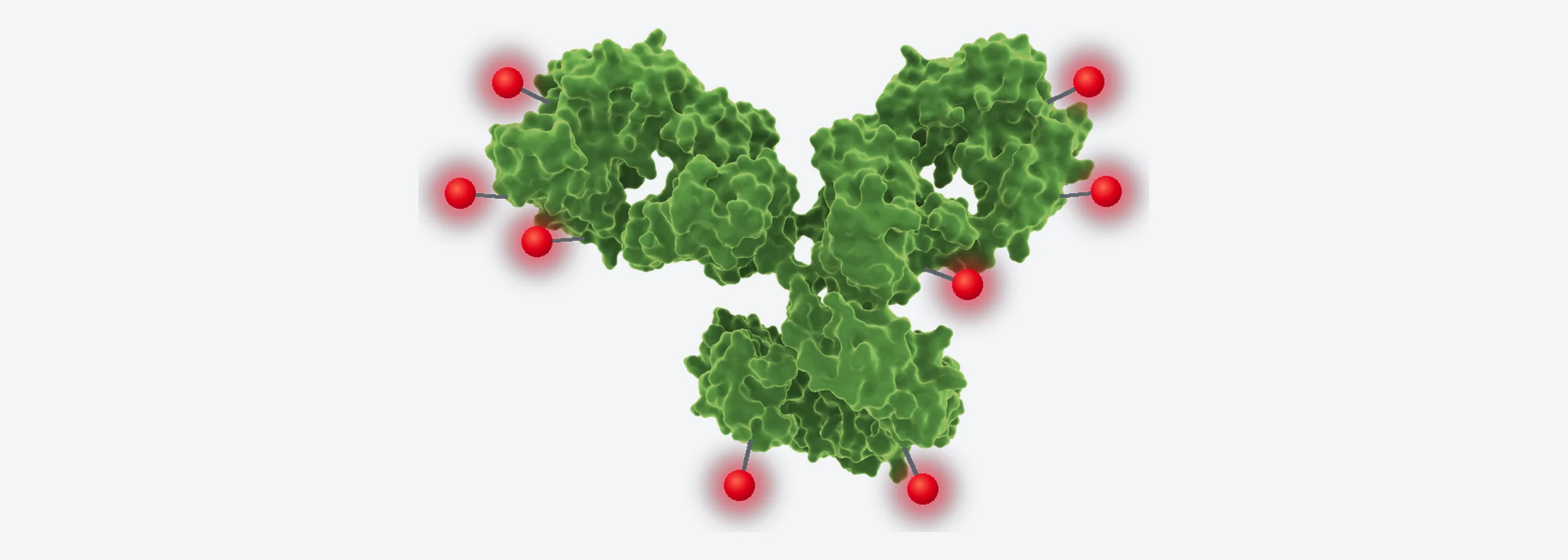
An antibody-drug conjugate starts life as one of the most robust molecules in biomanufacturing. Then conjugation bolts hydrophobic, highly potent drug-linkers onto its surface. What comes out is more valuable, more toxic and noticeably less stable than what went in, and it still has to be purified, concentrated and exchanged into its final buffer. That work happens in tangential flow filtration, usually on equipment chosen for the antibody the molecule used to be.
ADCs are no longer a niche. As more programs reach late-stage and commercial manufacturing, conjugate volumes are rising, and handling problems that were tolerable at small scale become yield, quality and safety problems at larger ones.
Three things, and each one raises the stakes in the steps that follow. First, hydrophobicity. Most payloads are hydrophobic, so every drug-linker attached makes the molecule stickier and more prone to self-association. Species with a higher drug-to-antibody ratio (DAR) are the least stable of all.
Second, a mixture, not a single molecule. A conjugation reaction produces a distribution of species with different drug loads. If handling stress aggregates the heavier-loaded species first, those aggregates are removed as yield loss and the DAR profile of what remains can shift.
Third, potency. The payload is cytotoxic at very low doses. Free drug-linker must be cleared to tight limits, operators must be protected, and every surface the product touches either has to be cleaned and verified or thrown away.
A typical conjugation train looks like the table below. TFF usually comes straight after the reaction, when the conjugate is at its least stable and the process stream still carries solvent and unreacted drug-linker.
| Step | Purpose | Handling risk |
|---|---|---|
| Antibody preparation | Buffer exchange and, for cysteine conjugation, partial reduction | Standard mAb handling |
| Conjugation and quench | Attach the drug-linker, usually dissolved in an organic co-solvent, then stop the reaction | Local solvent and payload excursions during addition |
| UF/DF (TFF) | Clear free drug-linker, co-solvent and quench reagents; exchange buffer; concentrate | Cumulative shear on a less stable molecule, a solvent-exposed wetted path, potent material in the loop |
| Polishing (where used) | Remove aggregates and narrow the DAR distribution | Aggregates formed upstream become yield lost here |
| Final formulation | Bring the conjugate to drug-substance concentration and buffer | Aggregation at high concentration |
The mechanisms are the same ones that cost yield in mAb UF/DF, but the molecule has less tolerance for them and the step runs longer.
Cumulative shear dose. In batch TFF the retentate recirculates through the pump many times. Each pass adds a little shear and interface exposure, and a hydrophobic conjugate turns that exposure into aggregates and subvisible particles faster than its parent antibody would.
More diavolumes, more passes. Clearing free drug-linker and co-solvent to specification often takes more diafiltration than a routine antibody buffer exchange. Every additional diavolume is more time in the loop, so the shear delivered per pass matters more here than almost anywhere else in antibody processing.
Pressure instability. A pulsing pump swings transmembrane pressure on every stroke, which worsens concentration polarization at the membrane, accelerates fouling and adds mechanical stress. See TMP stability for the mechanism.
Cavitation and air. Low-pressure zones on the suction side and entrained air create interfaces where hydrophobic molecules unfold and stick. The NPSH and cavitation article explains why pump inlet design matters.
The load-bearing idea: ADC UF/DF runs the pump longer, on a molecule that is less stable than the antibody it came from. The lever is shear per pass, not peak flow rate. See shear and mechanical stress in TFF.
At the start of diafiltration the retentate can still contain the organic co-solvent used to dissolve the drug-linker. Every wetted material in the loop, from pump to tubing to valves to bag, has to tolerate that solvent at its starting concentration for the full contact time. Alphinity's chemical compatibility reference covers the wetted materials in its flow paths.
Potency changes the equipment question too. A reusable stainless loop that has carried cytotoxic material has to be cleaned, and the cleaning verified, before the next batch or product. A closed, single-use flow path is used once and disposed of, which removes that cleaning burden and reduces open handling. Overall containment is still governed by the facility, its enclosure strategy and its exposure limits, so the TFF system is one part of that plan rather than the whole of it.
TFFi is a single-use tangential flow filtration system for concentration, diafiltration and final formulation from 30 mL to 10 L, in a closed, GMP-compatible flow path. That covers the post-conjugation UF/DF step for development, clinical and smaller commercial ADC batches, and the flow path is disposed of after use.
Inside TFFi is PIXER, a positive-displacement single-use diaphragm pump built for ultra-low-shear, near-pulseless flow. Every pass stays gentle, which is what counts when the diafiltration is long and the molecule is hydrophobic. Its gravity-flooded inlet removes the suction-side low-pressure zones where cavitation starts, and it keeps moving retentate up to 300 cP as the conjugate is concentrated.
PIXER is membrane-agnostic. Keep the cassette and molecular weight cutoff you have already qualified for your conjugate, and change the flow engine around it.
Pressure control is electric. VannX motorized single-use diaphragm valves, accurate to plus or minus 0.3 PSI, give closed-loop TMP control on 24V DC with no compressed air, so TMP stays steady through a long diafiltration.
The fastest way to see the difference is on your own conjugate. Prove-It runs your process at your site, unchanged, so you can compare recovery, aggregate levels and DAR profile against your current step using your own analytics.
Conjugation attaches hydrophobic drug-linkers to the antibody surface, so the conjugate is less stable than its parent. The higher the drug-to-antibody ratio, the more hydrophobic the molecule and the more readily it aggregates under shear, pressure swings and air-liquid interfaces. That makes the handling of the conjugate after conjugation, especially recirculation through the UF/DF pump, a bigger risk than it was for the unconjugated mAb.
The number is set in process development by the payload, linker, co-solvent level and the free-drug specification, and it is often higher than a routine mAb buffer exchange. Every extra diavolume means more passes through the recirculation pump. Because shear damage accumulates pass by pass, a low shear per pass matters more in ADC UF/DF than in almost any other antibody step.
The retentate entering UF/DF can still carry the co-solvent used to dissolve the drug-linker, such as DMSO or DMA, until diafiltration washes it out. Every wetted material in the flow path, including the pump, tubing, valves and bag, needs to be compatible with that solvent at its starting concentration and contact time. Check the wetted materials against your solvent system using Alphinity's chemical compatibility reference, and confirm the specific case with the Alphinity engineering team.
A closed, single-use flow path reduces open handling and removes the need to clean and validate the removal of potent residues from reusable equipment, and the whole flow path is disposed of after the batch. Overall containment is still set by the facility, its enclosure or isolator strategy and its exposure limits, so the TFF system should be assessed as one part of that plan.
Why damage accumulates pass by pass, and what sets the shear dose in a recirculation loop.
The parent molecule: aggregation, viscosity and TMP stability in mAb UF/DF.
Processing antibody-drug conjugates?
Speak to an engineer