Most diafiltration steps are specified in one line of a batch record: exchange into formulation buffer, seven diavolumes. Where the seven came from is usually harder to find.
Sometimes it came from a calculation. More often it came from the previous process, a platform document, or a number that worked once and was never revisited. That holds up until the molecule changes, the thing you are trying to wash out behaves differently than expected, or someone asks why the step takes four hours.
This article is about choosing the number on purpose. If you want the vocabulary first (flux, conversion, retention, what a diavolume is), start with The Language of TFF. Here it is assumed, and the focus is design.
The arithmetic everyone uses
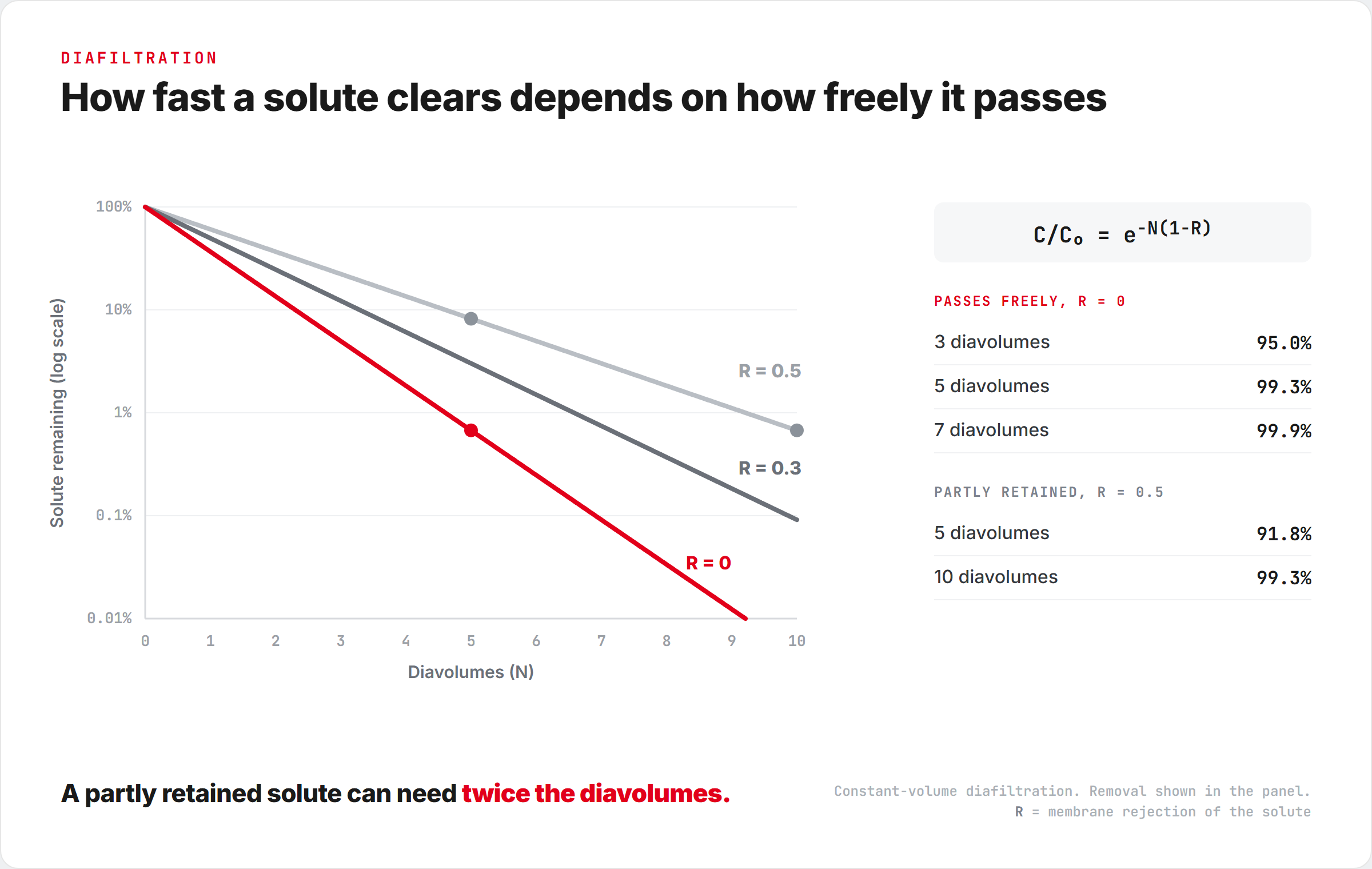
In constant-volume diafiltration, fresh buffer goes in at the same rate permeate comes out, so the retentate volume stays fixed. The fraction of a solute left after N diavolumes is:
R is the membrane's rejection of that solute. Zero means it passes straight through; one means it is fully held back. Salts and small buffer components on an ultrafiltration membrane sit close to zero, and the familiar numbers follow.
| Diavolumes (R = 0) | Remaining | Removed |
|---|---|---|
| 3 | 5.0% | 95.0% |
| 5 | 0.67% | 99.3% |
| 7 | 0.09% | 99.9% |
| 10 | 0.005% | 99.995% |
Each further factor of ten costs about 2.3 diavolumes, which is ln 10. So the step from 99% to 99.9% is not a rounding exercise. It is roughly the same buffer and the same time again, spent on a tenth of what was left.
When the solute doesn't pass freely
Most platform numbers quietly assume R = 0. For sodium chloride that is a good assumption. For a lot of other things you might want out of a retentate, it isn't.
Surfactants above their critical micelle concentration form micelles that a tight membrane partly holds back. Some excipients and small molecules bind to the protein and travel with it. Hydrophobic species, free drug-linker after an ADC conjugation among them, can associate with the product or stick to surfaces and clear more slowly than their size would suggest. Each of these pushes the effective R above zero, and the exponent shrinks with it.
The effect is large. At an effective rejection of 0.5, five diavolumes remove about 92% rather than 99.3%, and matching the R = 0 result takes ten.
Twice the buffer, and twice the time in the loop.
So the first design question is less "how many diavolumes" than "what exactly am I clearing, and have I measured how it clears?" A small-scale run sampled at every diavolume, assayed for the species itself rather than inferred from conductivity, answers that in a day. Finding out at scale costs a batch.
Constant-volume or discontinuous?
There are two common ways to run the exchange. Constant-volume diafiltration feeds buffer continuously while permeate leaves. Discontinuous diafiltration, sometimes called sequential dilution, dilutes the retentate with a charge of buffer, concentrates it back down, and repeats.
Discontinuous is easy to run by hand and needs no matched feed rate. It is also less efficient with buffer. A twofold dilution followed by re-concentration uses one diavolume and halves the solute, where one diavolume of constant-volume exchange leaves 37%. To reach 99% removal, constant-volume exchange needs about 4.6 diavolumes and twofold sequential dilution about 6.6. Bigger dilution steps are worse again per liter of buffer.
What constant-volume exchange asks for in return is control. The buffer feed has to track the permeate rate closely, normally by weight or level, and the loop has to hold steady pressure and crossflow for the whole exchange. Discontinuous operation swings the retentate between dilute and concentrated every cycle, and viscosity, TMP and flux swing with it.
Where in the process to diafilter
The usual sequence is concentrate, diafilter, concentrate again: UF1, DF, UF2. The real decision is how far to take UF1 before the exchange starts.
Concentrating first shrinks the retentate, so each diavolume is fewer liters of buffer. But flux falls as concentration rises, so each of those liters takes longer to get through the membrane. Under the classic gel-polarization model, total diafiltration time is lowest when the retentate sits at the gel concentration divided by e, about 37% of it. The result dates to 1976 and is still in the textbooks.
It is a good starting point and an incomplete answer. Real flux curves rarely follow the model exactly, and the model says nothing about the product. At higher concentration the retentate is more viscous, the pump works harder to hold crossflow, and each pass delivers its shear to more molecules at once. For a robust antibody that trade is often acceptable. For a conjugate, a viral vector or a lipid nanoparticle, the time-optimal concentration deserves a second look against aggregate and potency data, not just the clock.
The retentate is not quite the buffer you pumped in
At high protein concentration, a charged protein holds its counterions close. Charged buffer species and excipients then distribute unevenly between retentate and permeate, and the final retentate can differ measurably in pH and excipient level from the buffer that went in. This is the Gibbs-Donnan effect, and it grows as the target concentration climbs.
It is one of the more common reasons a formulation step lands just outside specification after a textbook exchange. The fixes are unglamorous: offset the diafiltration buffer so the retentate finishes where you need it, and measure pH and excipients in the retentate rather than assuming them from the permeate.
What a diavolume costs at the pump
Every diavolume is a retentate volume of buffer. It is also a block of time, and at fixed membrane area and flux, time scales directly with the number of diavolumes. In a recirculating loop, time is passes through the pump.
This is where the diafiltration number stops being purely a chemistry decision. Ten diavolumes instead of five doubles the cumulative shear the product sees and doubles the time the membrane spends under pressure. If transmembrane pressure swings with every pump stroke, those swings repeat for the entire exchange (see TMP stability).
The target, then, is the smallest number of diavolumes that reliably clears the species that matters. Measured, not inherited, and run on a loop that does as little damage per pass as it can.
Where Alphinity fits
TFFi™ runs concentration, diafiltration and final formulation from 30 mL to 10 L in a closed, single-use flow path. Its PIXER® pump delivers ultra-low-shear, near-pulseless flow, and VannX™ valves hold TMP under closed-loop control to within plus or minus 0.3 PSI, so a long exchange runs at steady pressure instead of cycling on every stroke. The same system runs the small-scale clearance study and the step it turns into.
Common questions
What is diafiltration?
Diafiltration is a tangential flow filtration step that removes or exchanges small molecules, such as salts, buffer components or residual reagents, by adding fresh buffer to the retentate while permeate is removed. The product is retained by the membrane, so it finishes in the new buffer.
How many diavolumes are needed for diafiltration?
For a solute that passes freely through the membrane, about 3 diavolumes remove 95%, 5 remove about 99.3% and 7 remove about 99.9%, following C/C0 = e^(-N(1-R)). Solutes that are partly retained, bind to the product or form micelles clear more slowly and can need twice as many, so the number should be confirmed by measuring clearance of the specific species.
What is the difference between constant-volume and discontinuous diafiltration?
Constant-volume diafiltration adds buffer at the rate permeate leaves, holding the retentate volume fixed. Discontinuous diafiltration repeatedly dilutes and re-concentrates the retentate. Constant-volume uses less buffer for the same clearance: about 4.6 diavolumes for 99% removal, against about 6.6 with twofold dilution steps.
At what concentration should you diafilter?
Concentrating before diafiltration reduces buffer volume, but flux falls as concentration rises. Under the gel-polarization model, diafiltration time is lowest at about the gel concentration divided by e. For viscous or shear-sensitive products, a lower concentration is often chosen to reduce the stress delivered on each pass.
Why is the retentate pH different from the diafiltration buffer?
At high protein concentration, the Gibbs-Donnan effect causes charged buffer species and excipients to distribute unevenly between retentate and permeate. The retentate pH and excipient levels can therefore differ from the diafiltration buffer, so they should be measured in the retentate and the buffer adjusted if needed.
Ng P, Lundblad J, Mitra G. Optimization of solute separation by diafiltration. Separation Science, 1976; 11(5): 499-502. The original derivation of the optimum diafiltration concentration under the gel-polarization model.
What to read next
The vocabulary behind every diafiltration calculation.
Why damage accumulates pass by pass, and what sets the shear dose.