Applications · Ex utero development
Artificial womb and ex utero programs are moving from experiment to reality. Each depends on a sterile, continuously renewed fluid environment, moved gently and precisely for weeks at a time. It is the same problem we solve every day for the most fragile biologics.
INTERPHEX 2026 award winner, Best Technology InnovationWhat does an artificial womb need from its fluid system?
An artificial womb keeps a developing organism in a sealed bag of synthetic amniotic fluid that is recirculated around the clock, while gases and nutrients are exchanged through a separate circuit, much like a placenta. That fluid path has to stay closed and sterile for weeks, recirculate gently at a low and steady pressure, deliver precise flow at milliliter scale, and fit a bag geometry built for the program. In practice, the fluid system is the life support.
The challenge
One breach ends the run. The fluid path must be single-use, sealed and built clean.
Synthetic amniotic fluid is recirculated around the clock, today often by pumps that squeeze tubing on every turn.
Held near natural amniotic pressure, with no pulsation or pressure spikes.
Small-animal models start at milliliters, and must scale up from there.
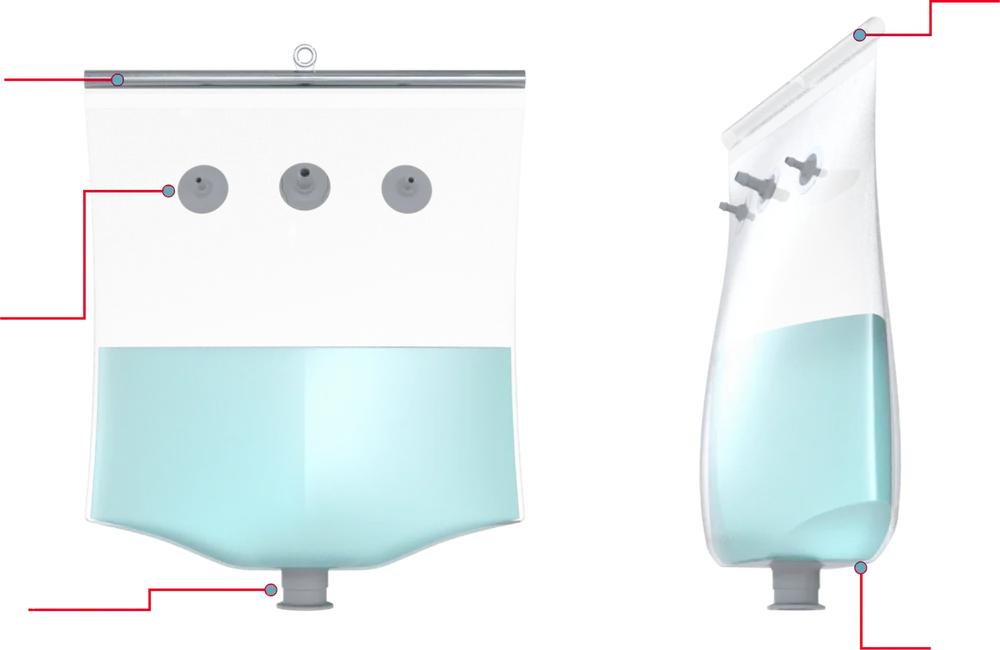
Every program needs its own bag geometry, ports and connections.
What we provide
HangerCustom port layoutSanitary clamp outletHanger sleeveTapered 2.5D base

An ex utero run cannot be watched by hand for weeks. ProCaaSo®, the cloud-native process control platform from our sister company ConSynSys, automates the whole fluid path, holds flow and pressure where the program needs them around the clock, and gives the team a live view of every reading, every alarm and every change across the whole run.
Pump speed, valves and pressure are controlled together from live sensor data. In a demonstration run on our TFFi™ system, pressure held within ±0.1 PSI of setpoint.
Every flow, pressure, alarm and intervention is recorded as contextual data. Trends stay visible over weeks, and alarms flag drift before it becomes a problem.
Control runs locally on an edge device and continues for up to seven days without a cloud connection. Research data stays in your own single-tenant, zero-trust cloud environment.
Recirculation, exchange and additions run as ISA-88 recipes, start to finish, the same way every time. The system holds setpoints, logs every step and alerts the team when it needs them, so people supervise the run instead of tending the pump.
ProCaaSo® does not just switch a pump on and off. It runs every device in the fluid path as one coordinated system, and turns everything that happens into data your team can see, trust and use.
What you control
What you see
What it enables
Cloud-connected. Secure by design.
Control runs in real time at the edge, right next to the fluid path. The cloud adds what a bench controller cannot: a live view of the run from anywhere, every reading kept in one place for the whole program, and room to grow from one system to a facility. All of it sits on the kind of security architecture banks rely on to protect financial data.
ProCaaSo® is developed by our sister company, ConSynSys Technologies.
How we work with you
Volumes, flows, pressures, run length and scale-up path.
Custom bags from our cleanroom and a fluid circuit sized to your model.
Fast design turns as your program learns.
One architecture from small-animal models to larger ones.
Why Alphinity
Our equipment was designed for viral vectors, mRNA and cell therapies: products that lose potency when they are pumped too hard, pulsed or exposed to cavitation. The principles that protect a fragile biologic, a flooded inlet, steady flow, no squeezed tubing and a closed single-use path, are the same ones a living system depends on.
Our TFFi™ system, built on the same pump and fluid path, won Best Technology Innovation at INTERPHEX 2026.

FAQ
An artificial womb needs a sealed single-use bag to hold synthetic amniotic fluid, a pump to recirculate that fluid continuously, a way to add and exchange fluid and nutrients, and sensors and control to hold flow and pressure steady. A separate circuit handles gas and nutrient exchange through the umbilical vessels. The whole fluid path has to stay closed and sterile for weeks.
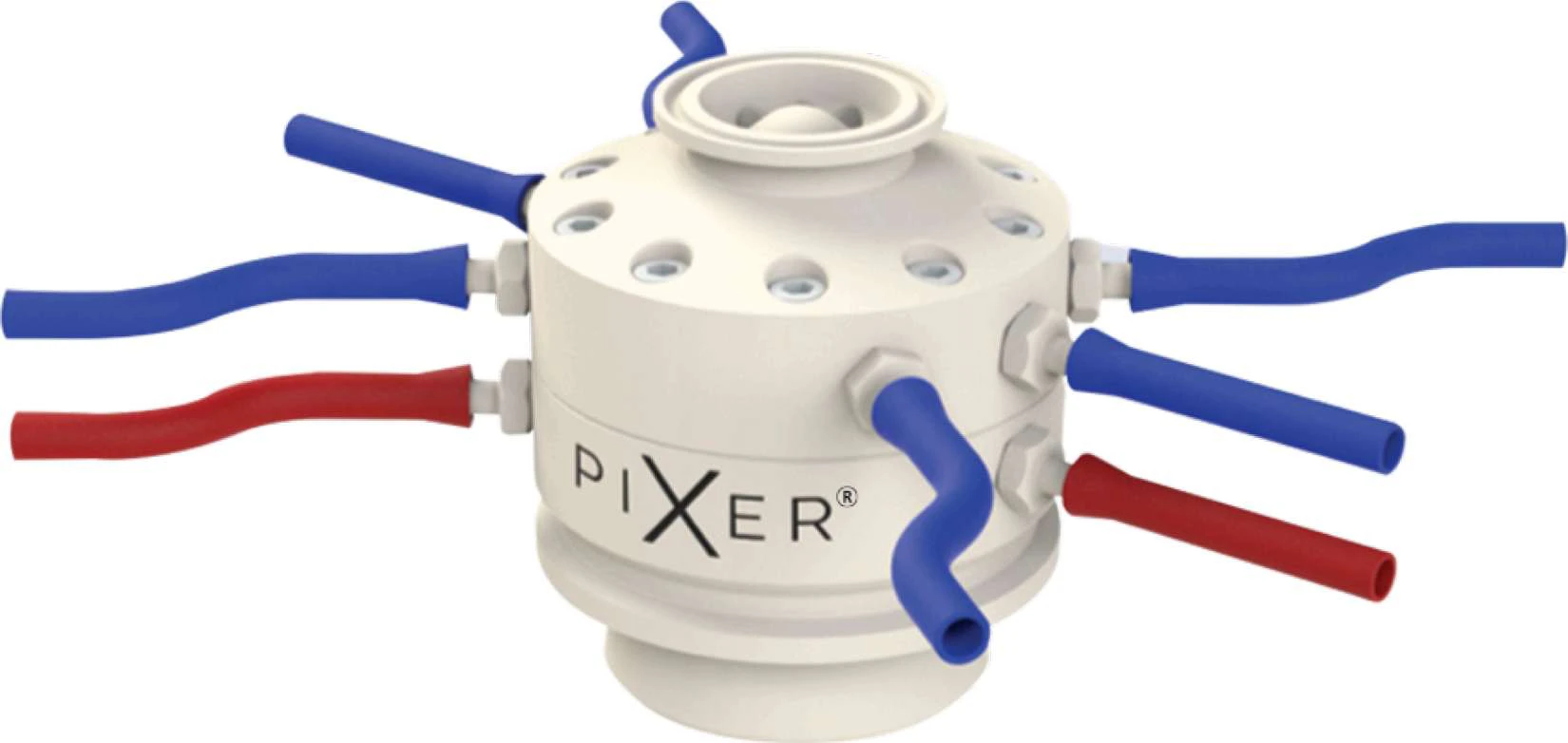
A gentle, low-pulsation pump that is precise at small flow rates and uses a closed single-use fluid path. A gravity-fed inlet avoids suction-side cavitation, an odd number of diaphragms keeps flow and pressure steady, and a diaphragm pump avoids squeezing tubing, so there is no tubing wear or particle shedding.
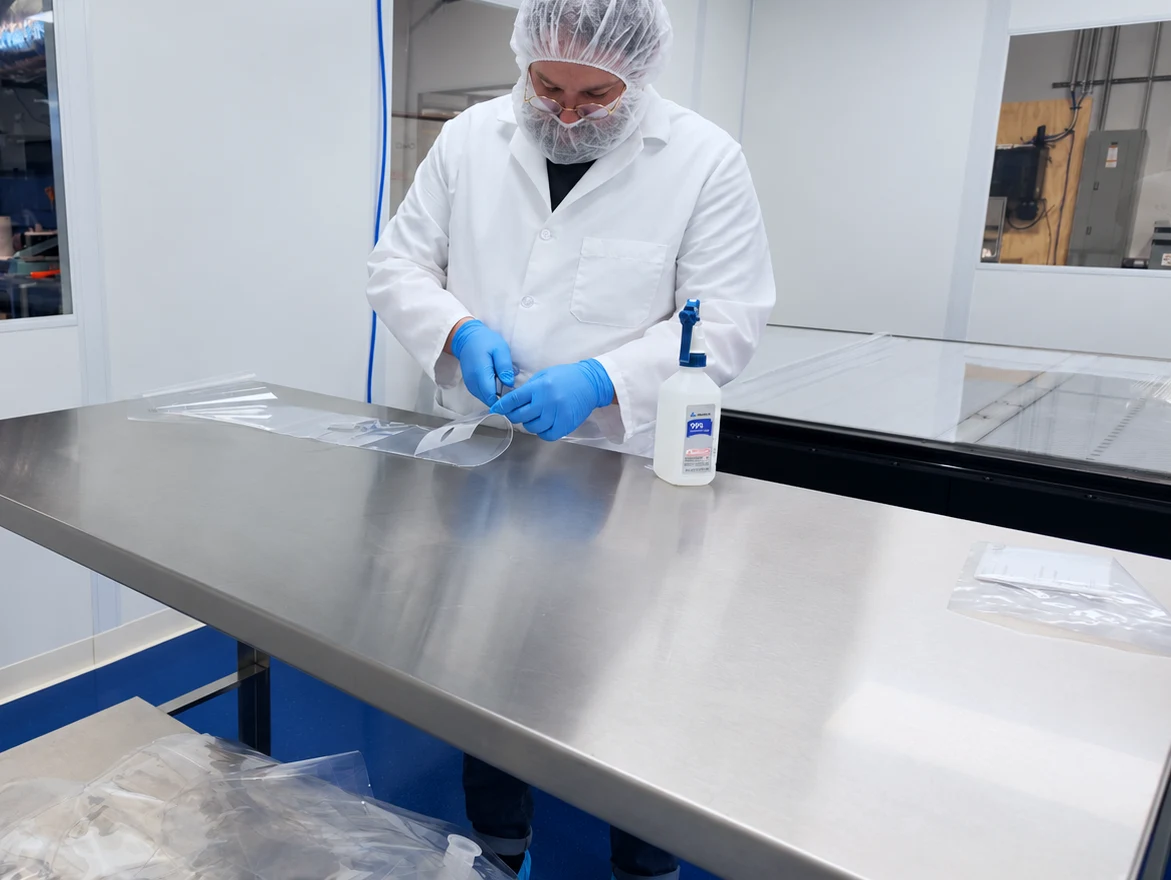
Yes. Alphinity designs and makes custom single-use bags in its own cleanroom, on bag technology protected by five granted patents. Geometry, volume, port number and port location are designed around each program, from first prototype to repeat supply.
The PIXER platform delivers linear, repeatable flow from under 1 mL/min, with turndown of up to 3,000:1, so the same pump architecture can serve small-animal models and scale up from there.
Yes. PIXER pumps can be fitted with injection ports that meter additional components directly into the flow inside the pump, so nutrients and other additions are mixed as the fluid is pumped.
No. Alphinity equipment is available to research and development programs. Alphinity works with partners on the regulatory pathway for clinical applications.
Alphinity fluid systems can run on ProCaaSo, the cloud-native process control platform from sister company ConSynSys. It holds flow and pressure steady from live sensor data, records every reading, alarm and intervention for the whole run, automates recirculation and additions end to end as repeatable ISA-88 recipes for walk-away operation, with alerts when the team is needed, and keeps control running locally for up to seven days without a cloud connection.

Related: Single-use bags · Organ perfusion fluid systems
Published research: Partridge EA et al. An extra-uterine system to physiologically support the extreme premature lamb. Nature Communications, 2017. doi:10.1038/ncomms15112
Get Started
Tell us what you are building: the model, the volumes, the flows and how long it has to run. We will help design its fluid path.
For research and development programs. We work with partners on the regulatory pathway for clinical applications.