Continuous bioprocessing is usually argued on economics and facility design: smaller footprints, higher productivity, steadier product quality. For the equipment that actually moves the fluid, the question is shorter and harder. Can it do the same job without stopping for a month?
Nearly everything that changes follows from that. This article looks at continuous processing from the fluid path outward, at what it asks of pumps, valves and filtration, and of the data that tells you they are still doing their job.
What "continuous" usually means
Very few plants are continuous end to end. In practice the word covers a range. Upstream it means perfusion, where cells stay in the bioreactor for weeks while media is fed and product is harvested. Downstream it means connected steps such as multi-column capture chromatography, continuous virus inactivation and single-pass TFF. And many facilities run hybrids, with a continuous upstream feeding batch downstream or the other way around.
What they share is that steps run far longer than a batch step does, and hand material straight to one another instead of through a large hold tank.
Duration and coupling. Those are the two things the equipment feels.
Duration: from hours to weeks
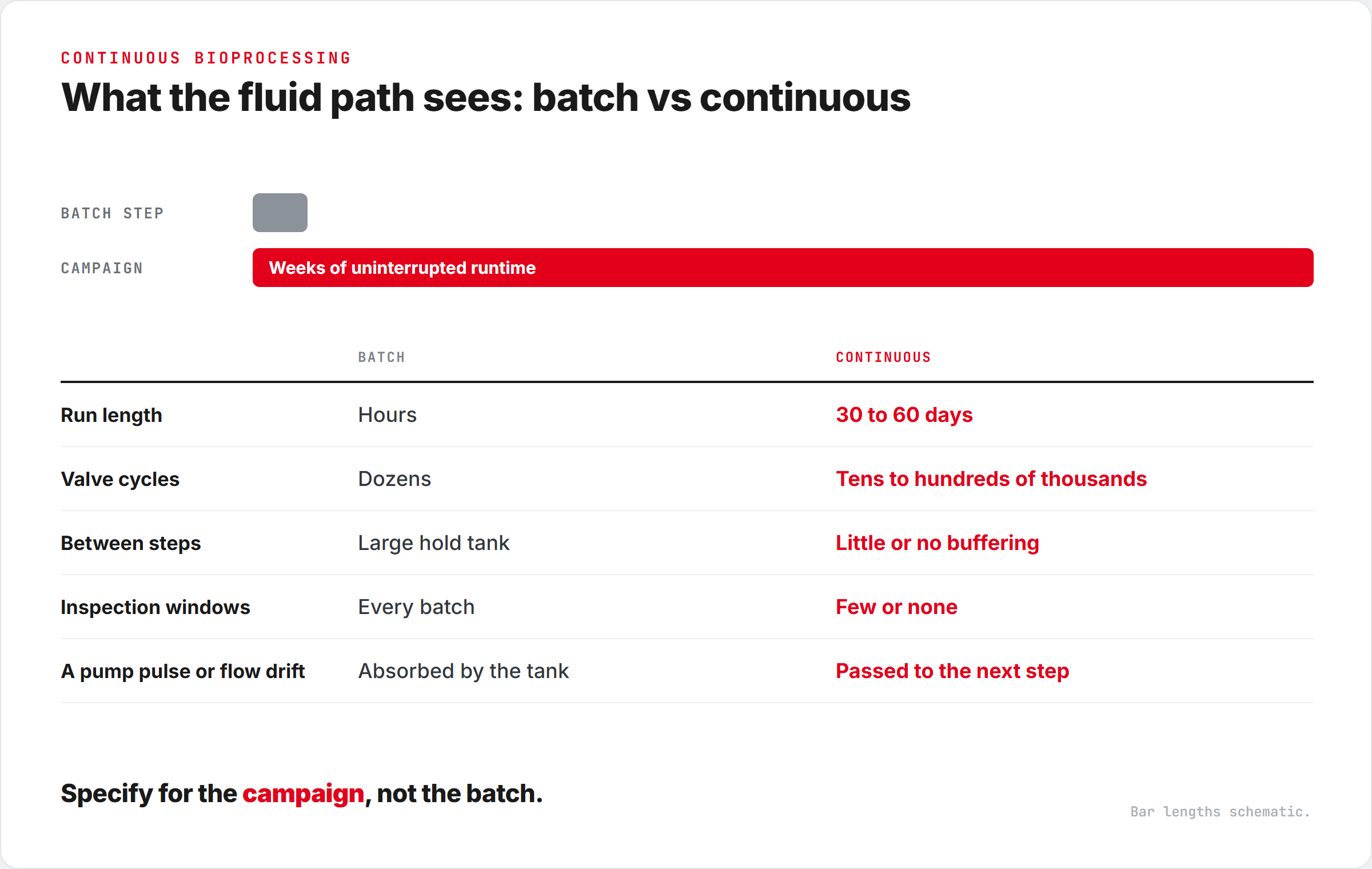
A batch UF/DF step runs for hours. A perfusion run or a connected campaign can run 30 to 60 days. Wear mechanisms that never had time to matter in a batch now have time to run their course.
Counting cycles makes this concrete. A control valve that actuates a few dozen times in a batch can reach tens or hundreds of thousands of cycles over a campaign. A pump runs the whole time, and every stroke or roller pass adds to its total. Tubing in a peristaltic head is compressed on every rotation, and over a long run it can fatigue, shed particles and drift in the flow it delivers (the peristaltic problem covers the mechanism).
None of that argues against continuous processing. It argues for specifying equipment for the campaign instead of the batch.
Coupling: nowhere for a disturbance to hide
In a batch train, a large tank between steps absorbs most upsets. If a pump pulses or a flow rate wanders, the tank averages it out and the next step never notices.
Connected processes shrink those buffers or remove them. The outlet of one step is the inlet of the next, so pulsation, flow drift and pressure excursions travel downstream with the product. A pump that pulses on every stroke is now sending that pulse into a chromatography column or a single-pass filter designed around steady flow.
Flow steadiness, in other words, becomes part of the process specification.
What changes, component by component
| Component | The batch question | The continuous question |
|---|---|---|
| Pumps | Does it deliver the flow and pressure this step needs? | Will it deliver the same flow on day 30 as on day 1, without pulsing the next step? |
| Valves | Does it open, close and hold its setpoint? | How many cycles before the setpoint drifts, and is that more than the campaign needs? |
| Tubing and wear parts | Is it compatible with the fluid? | Will it survive weeks of flexing and compression without shedding or creeping? |
| TFF | What flux and yield does the step achieve? | How does performance change over weeks of fouling, and how is that managed without stopping? |
| Monitoring | Was the step within limits? | Is each component still performing, measured while it runs? |
Pumps. Two properties dominate: whether delivered flow stays stable over time, and how much pulsation reaches the next step. A positive-displacement diaphragm pump avoids the tube wear and flow drift that come from squeezing a length of tubing thousands of times an hour. Its architecture then sets the pulsation. An odd number of diaphragms, evenly phased, cancels the even-order harmonics that an even count reinforces (diaphragm count and pulsation). The inlet matters too. A marginal suction condition that causes a little cavitation per hour causes it for the whole campaign, which is why a gravity-flooded inlet is worth more here than in a four-hour batch (NPSH and cavitation).
Valves. Continuous Campaigns covers this in depth. Diaphragm fatigue, sealing drift, actuation wear and compressed-air dependence all turn from per-batch non-issues into cumulative problems. Electric actuation takes the air supply out of the picture as a drift source for the entire run.
TFF. Connected downstream processes often use single-pass TFF (SPTFF), which concentrates the feed in one pass through a longer or staged membrane path instead of recirculating it. With no loop, the product isn't pumped round again and again, which helps fragile molecules. The catch is that one pass gives no second chance: conversion depends directly on steady feed flow and pressure. Upstream, TFF and related hollow-fiber devices retain cells in perfusion bioreactors for weeks, and the concern shifts to gradual fouling and to keeping the pumps and valves around the filter stable while it happens.
Buffers. A continuous process consumes buffer continuously. Preparing and storing weeks of it in tanks works against the footprint argument, which is why inline dilution from concentrates is common in connected processes (see buffer dilution).
When you can't stop to look
Batch processing has inspection built in. Between batches someone can swap tubing, check a valve or recalibrate a pump. A continuous campaign removes most of those windows.
So the equipment has to report on itself. An electrically actuated valve with encoder feedback already knows its position, the torque it needed to get there and the current it drew. Trended across a campaign, those signals show wear developing before it reaches the process, which is the argument behind the data-generating valve. The same thinking applies to a pump's drive current and speed at a given flow.
Most of the equipment in a continuous line is familiar. What has to change is the specification around it: written for the whole campaign rather than one batch, and asking each component to show how it is doing while it runs.
Where Alphinity fits
PIXER® is a positive-displacement single-use diaphragm pump with an odd diaphragm count and a gravity-flooded inlet, built for ultra-low-shear, near-pulseless flow. VannX™ motorized diaphragm valves are validated for 60-day continuous operation, with 24V DC actuation, no compressed air and encoder feedback that reports position, torque and current throughout the run.
Common questions
What is continuous bioprocessing?
Continuous bioprocessing runs manufacturing steps for extended periods, often weeks, with material passing directly from one step to the next rather than through large hold tanks. It includes perfusion cell culture upstream and connected downstream steps such as multi-column chromatography, continuous virus inactivation and single-pass TFF. Many facilities combine continuous and batch steps.
How does continuous processing change equipment requirements?
Equipment has to run for weeks instead of hours, so wear parts, cycle life and long-term stability become central to the specification. Because steps are coupled, pump pulsation and flow drift pass directly to the next step. And with fewer stops for inspection, components need to report their own condition while running.
What is single-pass TFF?
Single-pass tangential flow filtration (SPTFF) concentrates the feed in one pass through a longer or staged membrane path, rather than recirculating it through a loop. It avoids pumping the product repeatedly and suits connected processes, but it depends on steady feed flow and pressure because there is no second pass.
Which pumps suit continuous bioprocessing?
Pumps that hold delivered flow steady over weeks and add little pulsation to downstream steps. Peristaltic tubing fatigues under repeated compression and can shed particles and drift in flow over long runs. Positive-displacement diaphragm pumps with low pulsation and a flooded inlet avoid those tubing-wear mechanisms.
How long do valves need to last in continuous processing?
For the full campaign, with margin. A continuous run can demand tens or hundreds of thousands of cycles, so cycle life, sealing design and actuation matter more than in batch. Electric actuation removes compressed-air drift, and encoder feedback lets valve condition be tracked during the run.
What to read next
Cycle counts, fatigue and drift over a multi-week run.
Why an odd number of diaphragms breaks the harmonics an even count reinforces.