"Single-use or stainless?" is usually asked about a whole facility. It is easier to answer, and the answer is usually better, when it is asked about one unit operation at a time.
Most plants end up with both. This guide covers what each platform actually is, the four factors that decide between them, and how the choice tends to fall step by step through a typical train.
What each platform is
Stainless steel is fixed equipment. Vessels, piping and valves are installed once, cleaned in place (CIP) and steamed in place (SIP) between batches, and reused for years. It needs the utilities to support that: purified water, clean steam, cleaning skids and the validation that proves each clean worked.
Single-use replaces the product-contact parts with pre-assembled polymer assemblies: bags, tubing, connectors and filter capsules, supplied gamma irradiation compatible and closed. They are used for one batch or campaign and then discarded. The hardware around them, such as pumps, valve actuators, sensors and controls, stays in place and is reused.
The four factors that decide it
1. Batch size and scale. Single-use bioreactors are widely available up to about 2,000 L. Above that, stainless is still the norm. Downstream volumes are smaller, so single-use reaches further down the train than it does upstream, and the smallest, most valuable volumes near the end of the process are where it is most common.
2. Changeover and product mix. This is usually the strongest argument for single-use. Changing products in a stainless train means cleaning, verifying the clean and accepting some carryover risk. Changing a single-use assembly means removing one and installing the next. For multiproduct plants, clinical supply and contract manufacturing, that difference compounds with every changeover.
3. Campaign length. Long campaigns of one product spread cleaning cost over many batches, which favors stainless. Long continuous runs ask something different of single-use: the assemblies have to last the whole campaign, so tubing fatigue, wear and cycle life become part of the specification (continuous bioprocessing covers what weeks of runtime ask of the fluid path).
4. Capital and operating cost. Single-use needs less capital, fewer utilities and no cleaning systems, so a facility starts faster and for less. It moves cost into consumables and into a supply chain the plant now depends on. Stainless costs more to build and validate but less per batch once it runs. Which wins depends on how many batches the equipment will see.
Two more factors often settle a close call. Extractables and leachables matter more for single-use, because the product sits in contact with polymers, so material data and qualification are part of the choice. Waste and utilities cut both ways: single-use creates solid waste, while stainless consumes water, steam and cleaning chemicals every cycle.
Step by step through a typical train
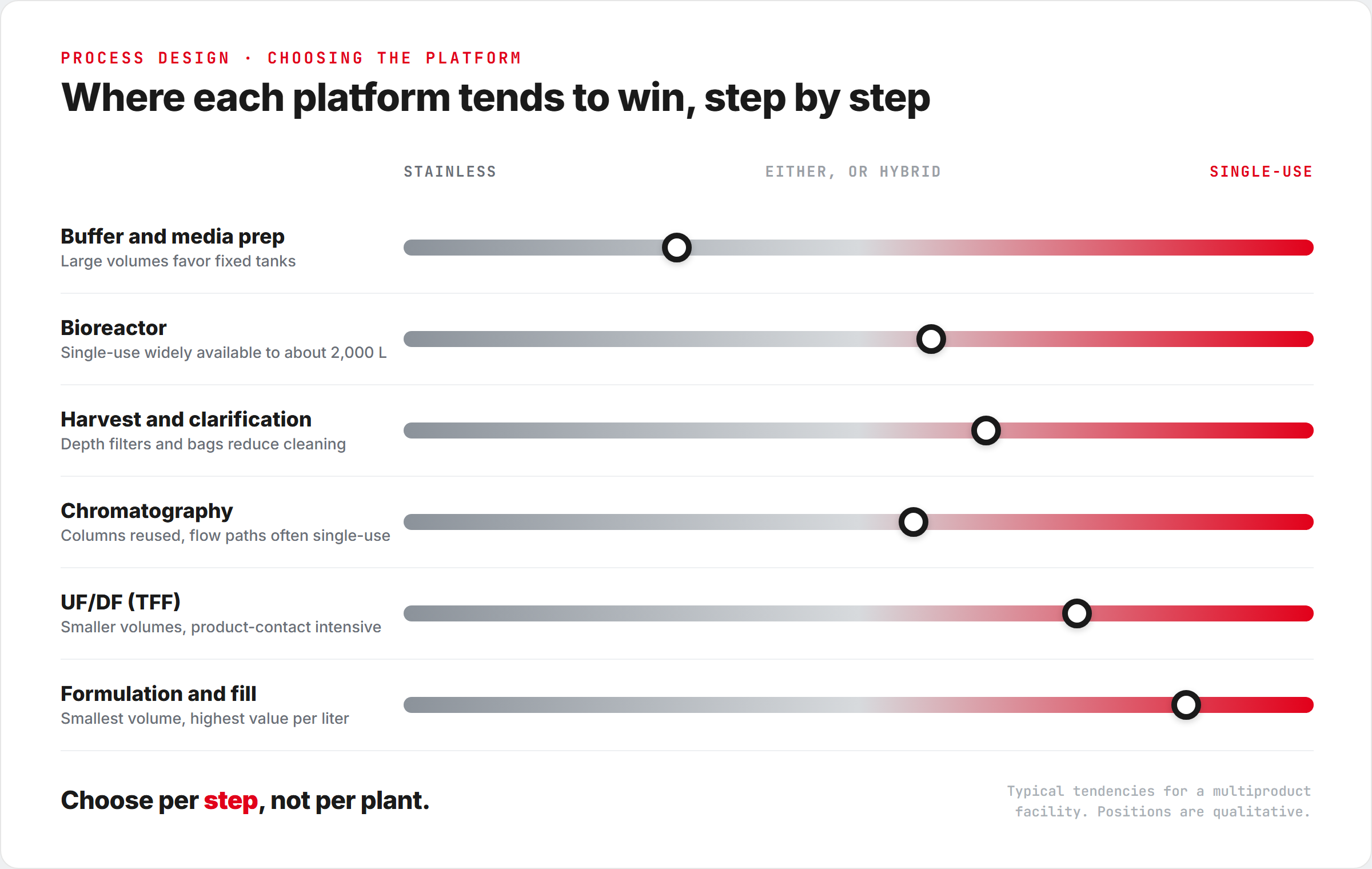
| Unit operation | Leans stainless when | Leans single-use when |
|---|---|---|
| Buffer and media prep | Volumes are large and recipes rarely change | Many recipes, or inline dilution from concentrates |
| Bioreactor | Working volume is well above 2,000 L | Volume is within single-use range and products change often |
| Harvest and clarification | Large, steady volumes justify centrifuges | Depth filtration in disposable capsules fits the volume |
| Chromatography | Large columns run long campaigns | Flow paths change per product, even if columns are reused |
| UF/DF (TFF) | Very large volumes of one product | Fragile or high-value product, frequent changeover |
| Formulation and fill | Dedicated, high-volume lines | Small, high-value batches and many presentations |
Hybrid is the normal answer
A common pattern is stainless for large-volume buffer and media preparation, with single-use for the product-contact steps downstream. It keeps consumable cost down where volumes are large and keeps changeover fast where the product is most valuable.
Hybrid moves the design work to the transitions. Wherever stainless meets single-use, a connection, a sample point or a transfer has to keep the process closed, and those points are where closed systems tend to open up. Valve choice matters here too: a diaphragm or pinch valve suits different positions in a mixed fluid path.
What the platform doesn't change
Switching to single-use changes the format of the fluid path, not its physics. A peristaltic pump squeezes single-use tubing as hard as it squeezed any other tubing (the peristaltic problem), and an imprecise valve controls pressure just as poorly in a bag-based system. The questions that protect the molecule, about shear, pulsation, cavitation and control accuracy, apply in both platforms.
So the platform decision and the fluid-path decision are separate, and both need making. Choosing single-use doesn't remove the need to choose a gentle pump and an accurate valve. It just means choosing ones designed for a single-use flow path.
Where Alphinity fits
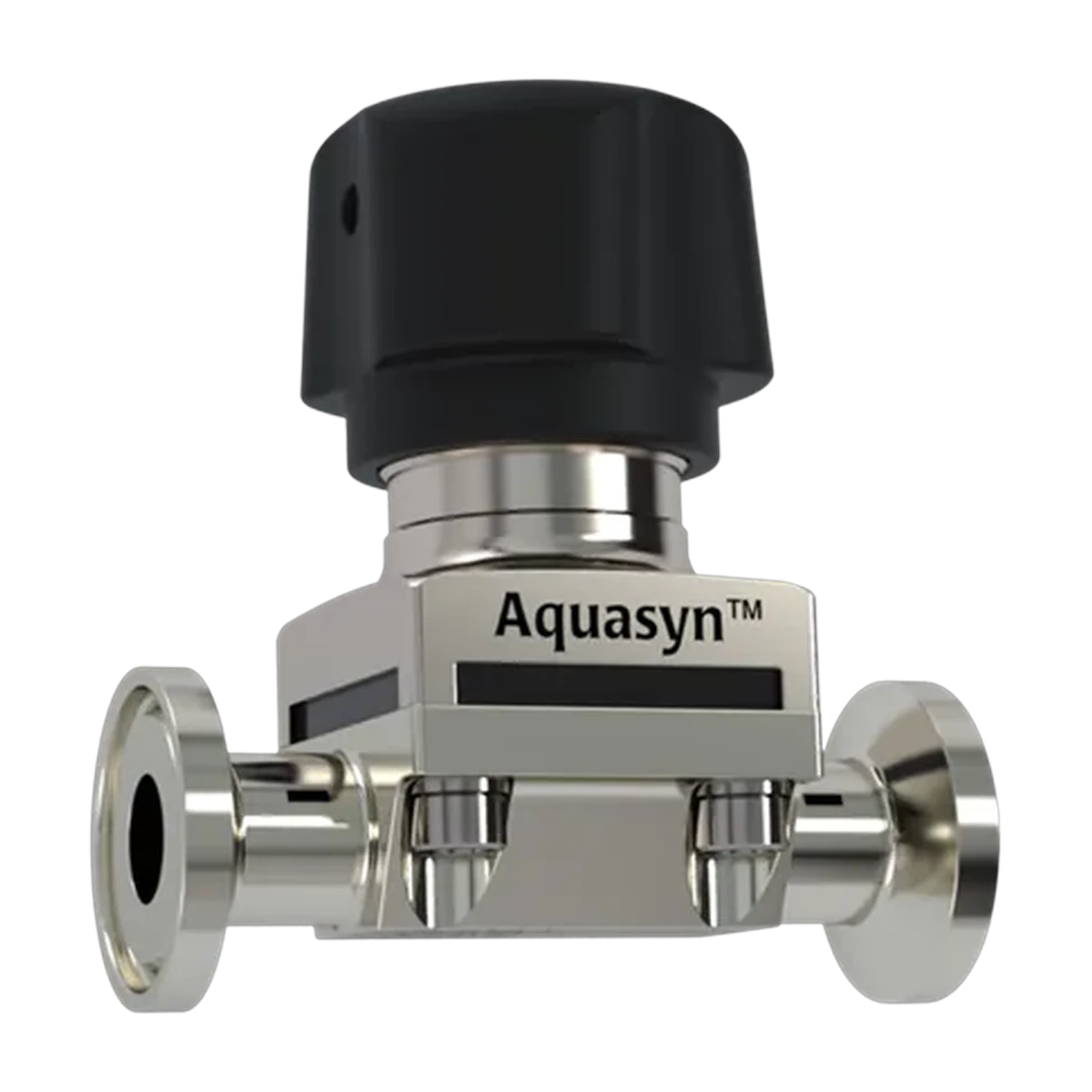
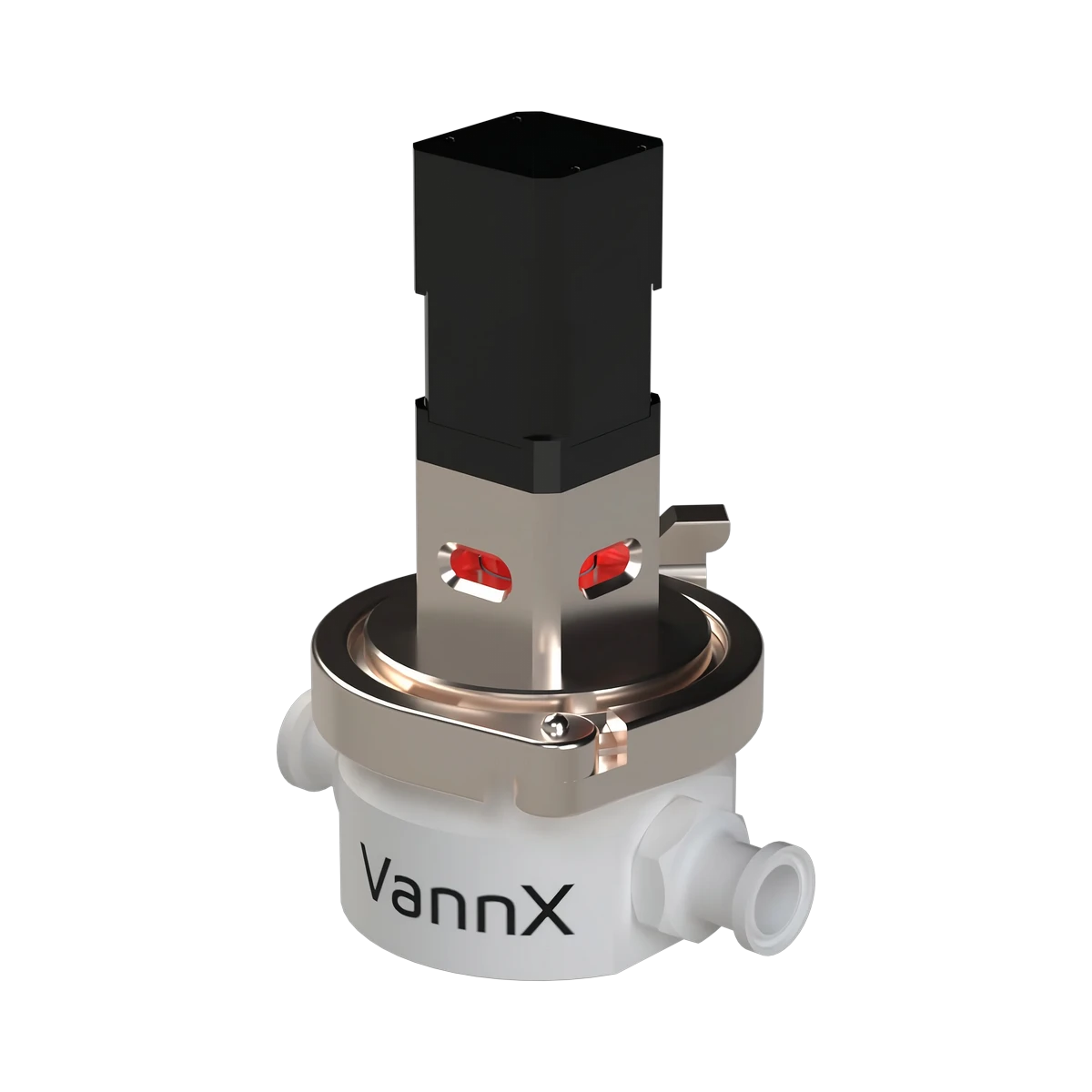
Our group covers both platforms. Aquasyn® machines hygienic stainless steel diaphragm valves from 316L bar in Carson City, Nevada. Alphinity designs the single-use side: PIXER® low-shear diaphragm pumps, VannX™ electric single-use valves and single-use bags designed into the fluid path. ARTēVA® pinch valves bridge the two, with a stainless pinch head on single-use tubing. ConSynSys™ ProCaaSo® control runs the same way across all of it, so a hybrid train is specified once, by one team.
Common questions
What is the difference between single-use and stainless steel bioprocessing?
Stainless steel equipment is fixed: vessels and piping are cleaned in place and steamed in place between batches, and reused for years. Single-use equipment replaces the product-contact parts with pre-assembled polymer bags, tubing and connectors that are gamma irradiation compatible, used for one batch or campaign and then discarded.
When does single-use make more sense than stainless steel?
Single-use suits frequent product changeover, smaller batches, multiproduct facilities, clinical supply and fast start-up, because it removes cleaning, cleaning validation and most carryover risk. Stainless suits long campaigns of one product at large scale, where cleaning cost is spread over many batches and consumable cost would dominate.
Is single-use cheaper than stainless steel?
Usually cheaper to build and faster to start, because it needs less capital, fewer utilities and no cleaning systems. It moves cost into consumables, so for long, high-volume campaigns of one product stainless can be cheaper over the life of the facility. The answer depends on batch count, scale and product mix.
Can a facility use both single-use and stainless steel?
Yes, and most do. A common pattern is stainless for large-volume buffer and media preparation and single-use for product-contact steps downstream. The design work then moves to the transitions between the two, where connections, sampling and transfers have to keep the process closed.
Does the platform choice change pump and valve selection?
It changes the format, not the physics. Shear, pulsation, cavitation and control accuracy affect the product the same way in either platform. A single-use flow path still needs a low-shear pump and accurate valves, and a stainless train still needs a fluid path designed around the molecule.
What to read next
Weeks of runtime, coupled steps and no inspection windows.
Choosing position by position in closed single-use systems.