In a stainless plant, the valve question was settled a long time ago. In a closed single-use system it comes back every time someone draws a new manifold, and the two usual answers, a diaphragm valve or a pinch valve, turn out to be more different than their shared job suggests.
Both stop and control flow without putting a moving part in the product. Past that, they diverge: what touches the fluid, where the wear happens, how finely each one controls, and what it takes to add one to an assembly that is already sealed.
The mechanisms themselves are covered in How Diaphragm Valves Work and How Pinch Valves Work. This article is about choosing between them.
The difference, briefly
A pinch valve closes by squeezing tubing from the outside. The tube is the only wetted part. The valve never touches the product.
A single-use diaphragm valve is a small molded body plumbed into the line, with a flexible diaphragm that an actuator presses against a weir. The body and diaphragm are wetted and disposable. The actuator is reusable and stays outside the fluid path.
Almost everything else follows from that.
| Pinch valve | Single-use diaphragm valve | |
|---|---|---|
| Wetted parts | Tubing only | Molded body and diaphragm |
| Hold-up in the valve | None beyond the tube | Small internal volume |
| Connections added | None | Two per valve |
| Adding to a sealed assembly | Clamps onto existing tubing | Designed in before sterilization |
| Fine flow and pressure control | Limited | Strong, especially with electric actuation |
| Wear item | The tube section under the pinch | The diaphragm |
| Most sensitive to | Tube ID, wall and hardness tolerance | Diaphragm cycle rating and body sizing |
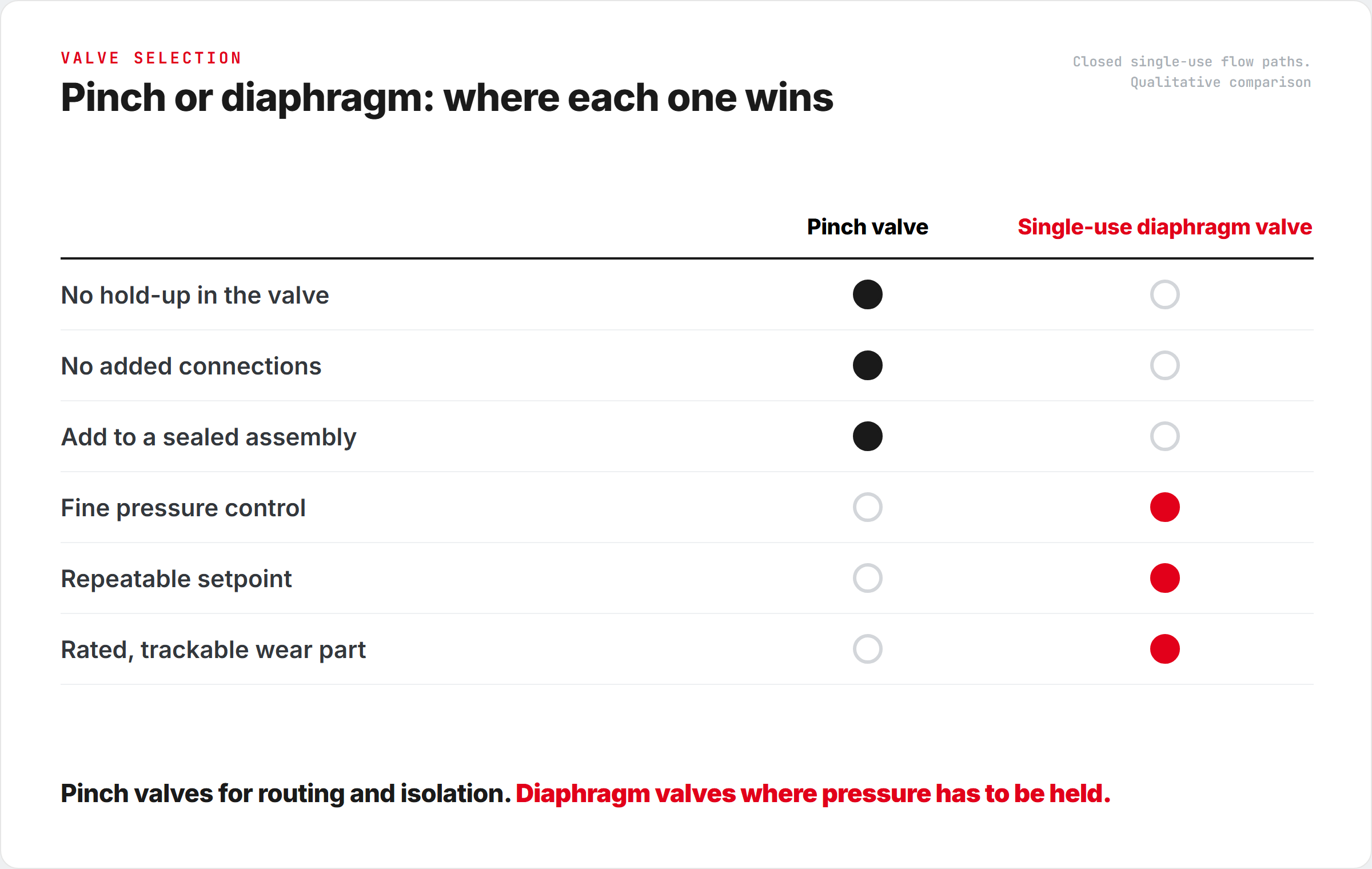
Where pinch valves win
Pinch valves are at their best where a clean, simple path matters more than precision: isolation, routing through a manifold, sampling lines, bag filling, drains.
Their biggest advantage in a closed system is easy to miss. Because the valve sits outside the tube, it can be added, moved or taken away without opening the fluid path. A manifold can be built from plain tubing, sterilized, and have its valving decided at the skid. Every diaphragm valve, by contrast, is two more connections that had to be designed in, assembled, integrity tested and then trusted for the life of the run.
Hold-up matters more than it sounds for small batches. In autologous cell therapy, where an entire batch can be a few hundred milliliters, product sitting in valve bodies and connectors at the end of a transfer is a real fraction of the dose.
Where diaphragm valves win
Once the job is control rather than open and shut, the balance tips the other way. Holding backpressure, setting transmembrane pressure in a TFF loop, splitting flow between two paths: each needs a valve whose position maps predictably onto flow and pressure.
A diaphragm seating on a weir gives you that. Pinched tubing is harder to throttle finely, because the relationship between jaw position and flow is steep near closure, and the tube's own elasticity and dimensional tolerance shift it from one tube to the next. Put a diaphragm valve on an electric actuator with encoder feedback and it can be positioned in very fine steps and hold a setpoint closed-loop. Pneumatic vs electric actuation and pressure control accuracy cover why the actuator matters as much as the valve.
Diaphragm valves also move the wear away from the tubing. The diaphragm is a rated component with a defined cycle life. In a pinch valve, the wear item is whichever few centimeters of tube happen to sit under the jaw.
The long-run question
Over a single batch, either type will usually be fine. Over a multi-week continuous campaign, the real question is what happens after tens of thousands of cycles in the same place.
Tubing under repeated compression can take a set, creep or crack, and silicone held closed for long periods may not fully spring back when released. A diaphragm fatigues too, but it is specified for cycle life, and when the actuator reports position and motor current, its condition can be followed while the run continues (see the data-generating valve).
Neither type is automatically right for long runs. What matters is knowing which part is using up its life, and specifying that part for the campaign rather than the batch.
A practical way to decide
Work through the system position by position rather than picking one valve type for the whole assembly. Four questions settle most positions:
- Does this position modulate, or only open and close? If it modulates pressure or flow, use a diaphragm valve. If it only isolates or routes, a pinch valve is usually the simpler answer.
- Could the valving change after the assembly is built? If so, pinch valves keep that option open without breaking sterility.
- What does hold-up cost here? For small, high-value batches, favor pinch valves wherever control isn't needed.
- How many cycles, over how long? Specify the tubing or diaphragm for the full run, with margin.
Plenty of good systems end up with both: pinch valves across the manifold for routing and isolation, and diaphragm valves at the handful of points where pressure or flow has to be held.
One boundary worth stating. Everything here is about single-use flow paths. Stainless diaphragm valves in cleaned and steamed systems follow a different logic, built around drainability, cleanability and body construction. Aquasyn, Alphinity's sister brand, covers those in its Engineering Notes.
Where Alphinity fits
Alphinity makes both. ARTēVA® pinch valves are reusable 316L stainless steel valves for single-use tubing, in manual, pneumatic and electric versions. VannX™ is a motorized single-use diaphragm valve with a disposable fluid path and a reusable 24V DC actuator, holding a pressure setpoint to within plus or minus 0.05 bar (0.7 psi) in closed loop, with no compressed air.
Common questions
What is the difference between a pinch valve and a diaphragm valve?
A pinch valve closes by compressing flexible tubing from the outside, so the tubing is the only wetted part. A diaphragm valve presses a flexible diaphragm against a weir inside a valve body, so the body and diaphragm are wetted. Pinch valves add no connections or hold-up; diaphragm valves give finer, more repeatable flow and pressure control.
Are pinch valves or diaphragm valves better for single-use systems?
Both are widely used. Pinch valves suit isolation, routing and sampling, and can be added to a sealed assembly without opening it. Single-use diaphragm valves suit positions that need modulation, such as backpressure or TMP control. Many systems use pinch valves across the manifold and diaphragm valves where pressure or flow must be controlled.
Can a pinch valve be used for pressure control?
For coarse throttling, yes. Fine pressure control is harder, because the relationship between pinch position and flow is steep near closure and depends on tubing elasticity and dimensional tolerance. Where a setpoint must be held tightly, an electrically actuated diaphragm valve with encoder feedback is usually the better choice.
Why are pinch valves used in closed cell therapy systems?
The valve sits outside the tubing, so it can be added or moved without breaking the sterile fluid path, and it adds no connections or hold-up volume. For small, high-value batches such as autologous cell therapies, avoiding product loss in valve bodies and connectors matters.
How long does pinch valve tubing last?
It depends on tubing material, dimensions, closing force and cycle count. Under repeated compression, tubing can take a set, creep or crack, so tubing life should be specified for the full campaign, particularly in high-cycle or continuous service.
What to read next
Why the actuator decides how precisely a diaphragm valve can control.
Diaphragm, pinch, check, ball and butterfly valves, and where each one fits.