Industry insight
On October 16, China’s Ministry of Commerce and Ministry of Science and Technology proposed banning the export of ownership rights to cell and gene therapy and small nucleic acid technology platforms.1 Licensing deals are exempt and comments are open until November 15, but the direction is clear.
It lands on an industry that has leaned hard on China for innovation. In 2025, 40% of the assets big pharma licensed in came from a Chinese licensor, up from just under 30% the year before.2 In the US, the BIOSECURE Act became law in December 2025, restricting federal work with biotechnology companies of concern, including their equipment.3 At the same time, pharma has pledged more than $370 billion in new US manufacturing.4
What it means
- 01
Capability is becoming something you own, not something you license.
When platforms can be licensed but not transferred, technology that can be fully owned, built and supported in the West carries a new kind of value.
- 02
The plants being designed now will set the next decade.
New US facilities opening around 2030 are being specified in 2026 and 2027. The fluid handling, control and data choices made now are hard to undo later.
- 03
Fragile modalities raise the stakes.
In vivo CAR-T, ADCs and RNA medicines are where the pipeline is heading, and where equipment matters most. Peer-reviewed work shows AAV capsids aggregate and fragment under repeated passes through a peristaltic pump.5
For the companies that make medicines, the question is shifting from “who do we buy from?” to “what capability do we need to secure?”
The problems we solve
The molecule changed. The equipment didn’t.

Much of today’s bioprocessing equipment was built for robust antibodies and water-like fluids. The industry’s answer to new modalities has been a bigger hammer. Ours is a better fit.

The most valuable molecules are the most fragile, and often the most viscous.
ADCs and viral vectors lose yield to shear and vacuum, while high-concentration feeds thicken past what standard pumps and filters can move. The equipment was designed for something tougher and thinner.
What we do: gentle, gravity-fed pumping and filtration built for shear-sensitive and viscous feeds alike, with TFFi tested to 300 cP.

Every new modality means a new equipment compromise.
Standard systems make the process bend to fit the hardware, and every change becomes a project.
What we do: modular systems built around the process from proven building blocks, with electric valves that hold position and pressure precisely.

Most systems record what happened, not why.
Data stays trapped on the skid at low resolution, so drift shows up late and every scale-up or tech transfer starts with guesswork.
What we do: every system runs on ProCaaSo® from our software sister company, ConSynSys. That means precise closed-loop control, the kind that holds TMP to ±0.1 psi over 16 hours, and high-resolution data from every run, ready for analysis, scale-up and tech transfer.
Don’t take our word for it. Bring the molecule to a Prove It run, below.
Alphinity news
Boston: from components to systems
On October 7 we brought the whole group to the ISPE Boston Product Show at Gillette Stadium: Alphinity, ConSynSys and Aquasyn, side by side.
TFFi™ and our viral inactivation system ran live all day under ConSynSys ProCaaSo® control, while our components table walked visitors through flow control from stainless steel to single-use.
The conversation has changed. A year ago visitors asked what TFFi was. In Boston they asked how soon they could have one. Systems are available from January.

Prove It · January runs
Prove it on your own molecule.
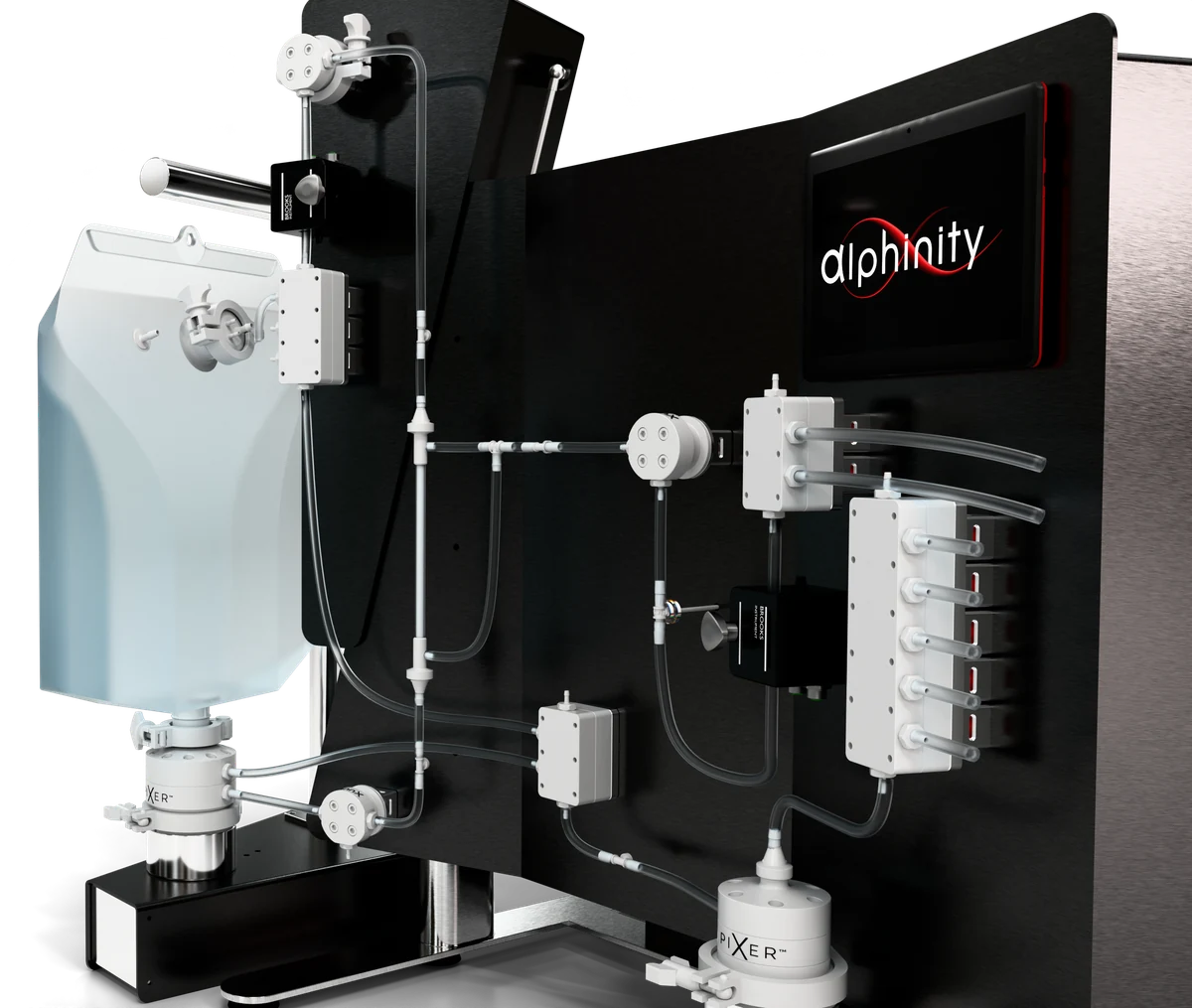
Before you commit, run your own process and material on TFFi, the 2026 Interphex Best Technology Innovation winner, with our engineers beside you.
- Your molecule, your process, from 30 mL to 10 L on one architecture
- Stable TMP data on your own feed, gentle low-shear processing
- A full batch report you keep: ISA-88 recipe, 21 CFR Part 11 audit trail
We are scheduling January runs now, and places are limited.
Virtual Tech Demo Day
See what Alphinity and ConSynSys are building next.
One live hour with the whole group. Watch the systems run, see the software in action, and put your questions straight to the engineers who built them.
Places are limited.
Sources
- Baker McKenzie, “China Proposes Expanded Export Controls on AI, Biopharma and Solar Energy Technologies,” Oct 18, 2026 (MOFCOM and MOST Announcement [2026] No. 48, draft). Link
- IQVIA, “Biopharma M&A outlook for 2026,” Jan 2026. Link
- Ropes & Gray, “BIOSECURE Act Enacted,” Jan 2026 (FY2026 NDAA, Sec. 851). Link
- Fierce Pharma, “Pharmas have promised $370B in US investments amid 2025’s onshoring boom: DPR.” Link
- Chaubal, Yehl, Zydney et al., AAV ultrafiltration study, Journal of Membrane Science (NSF public access record). Link