Four valve types do most of the work in bioprocessing: diaphragm, pinch, check, and ball or butterfly. But the type on the spec sheet tells you less than you would expect. What actually shapes your process is how the valve responds, how precisely it holds a position, and whether it can tell you where it is. Mechanism and actuation, more than category, decide the outcome.
What valve types are used in bioprocessing?
Bioprocessing uses four primary valve types. Diaphragm valves seal a flexible membrane against a weir or seat. Pinch valves compress flexible tubing from the outside. Check valves are passive and allow flow in one direction only. Ball and butterfly valves rotate an element to open or block the path. Each appears in different parts of a facility for different reasons.
There is also a second decision layered on top of every actuated valve: how it is actuated, pneumatically or electrically. That choice is frequently more consequential to the process than the valve body itself, and it is the one most often decided by default rather than by requirement.
How do diaphragm valves work?
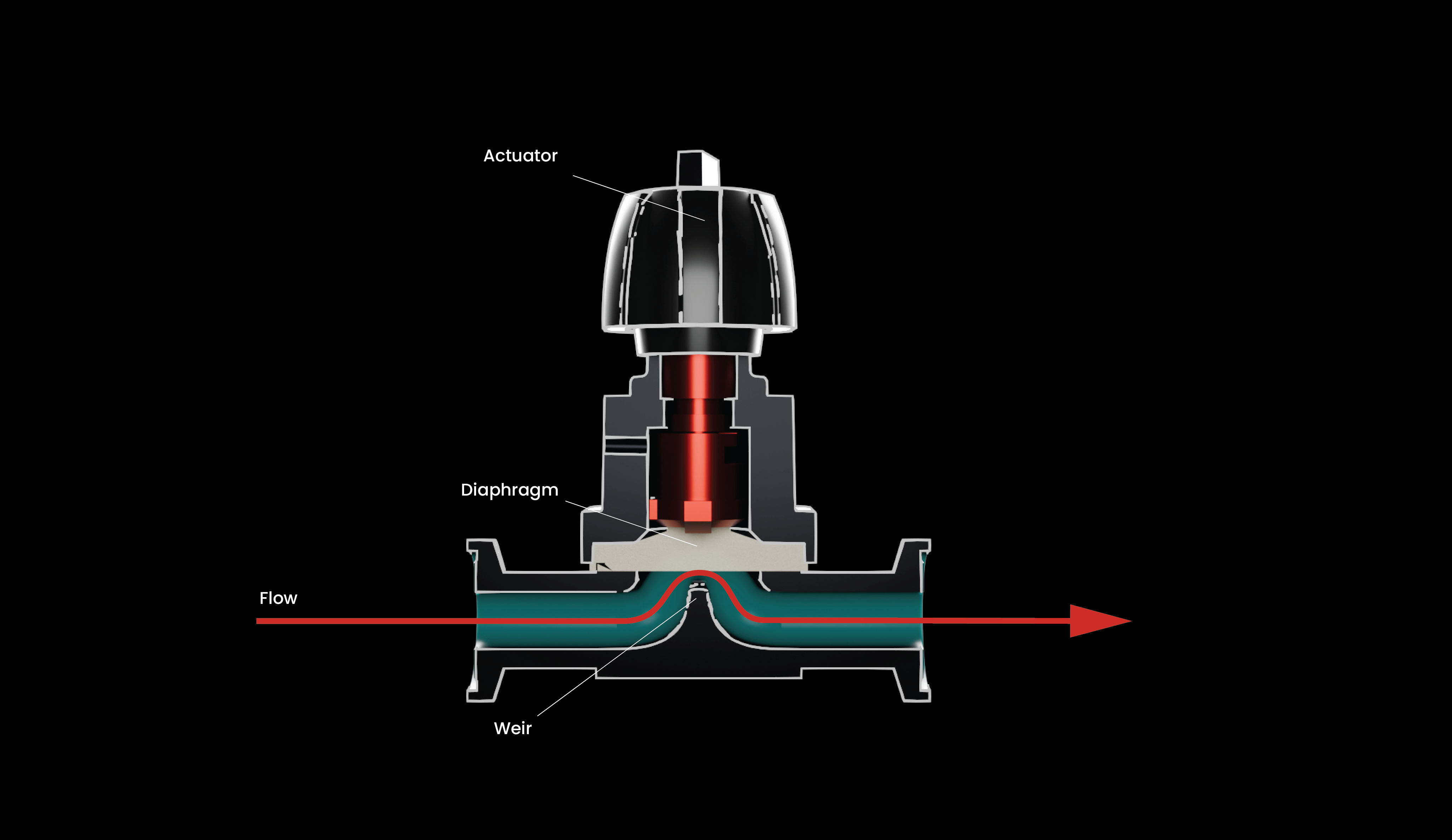
A diaphragm valve uses a flexible membrane (the diaphragm) pressed by an actuator against a weir or seat in the valve body. Raising the actuator lifts the diaphragm and opens the flow path; lowering it closes the seal. The diaphragm completely separates the product from the actuator and working parts, so the wetted path is just the body bore and the diaphragm face.
This is why diaphragm valves dominate hygienic and single-use bioprocessing. There are no dead legs, the geometry drains and cleans cleanly, and the same design supports precise throttling, not just on/off. Diaphragm material (EPDM, PTFE, or TPE) sets the chemical compatibility, temperature range, and cycle life, so it is specified to the process rather than chosen by default.
Electric diaphragm valves with encoder feedback support closed-loop pressure control in single-use systems; the principle is the same diaphragm-on-weir seal, with the precision coming from the actuation.
How do pinch valves work?
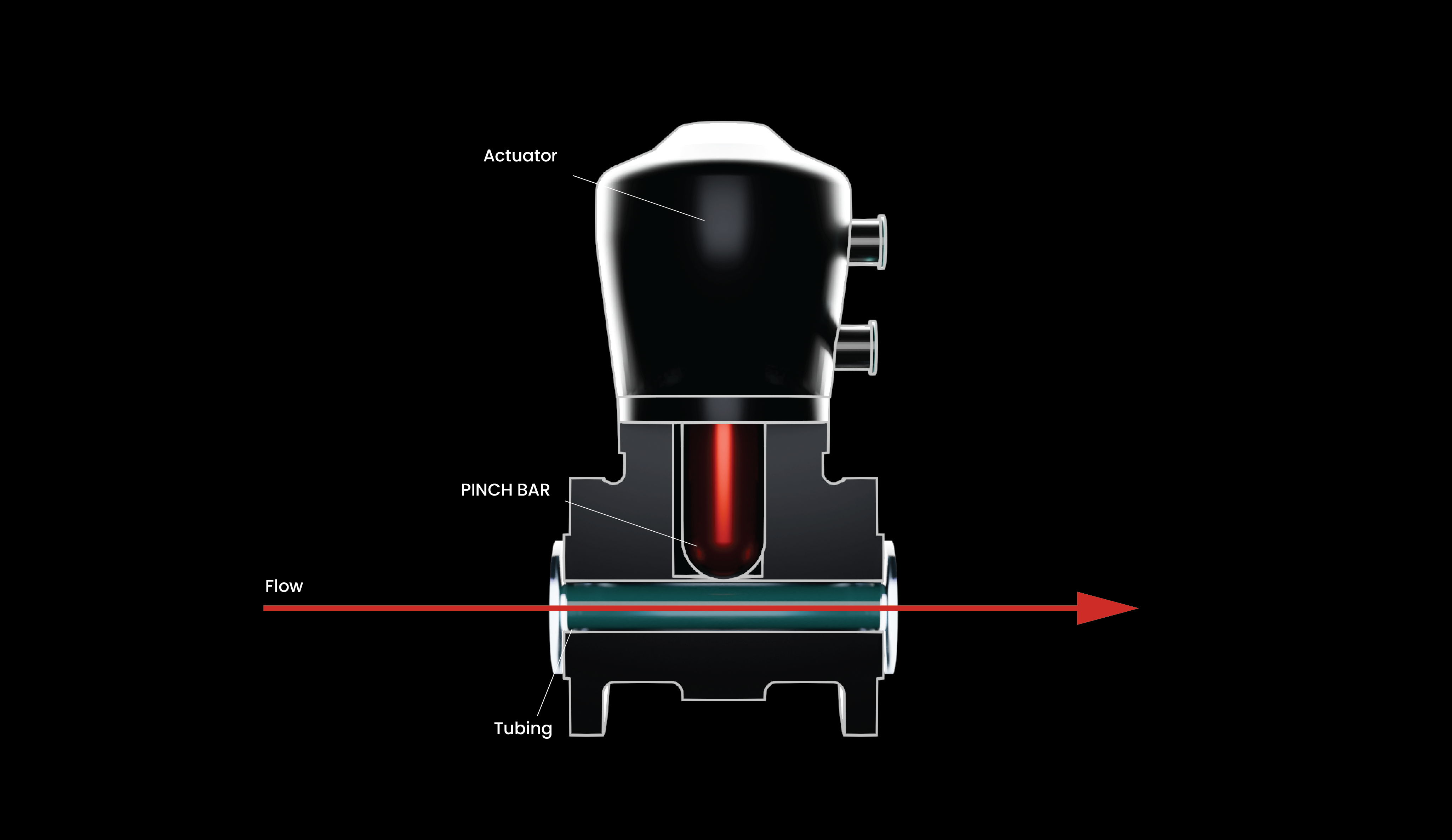
A pinch valve uses an external mechanism to compress a length of flexible tubing, restricting or fully stopping flow. Because the only wetted part is the tubing itself, nothing in the valve mechanism ever contacts the product. Replace the tubing and the flow path is renewed.
That makes pinch valves a natural fit for single-use and tubing-based systems. They are simple, reliable, and visible in operation. The trade-offs are inherent to the mechanism: fine proportional control is harder than with a diaphragm valve, and the tubing fatigues over repeated compression cycles.
Alphinity's ARTeVA pinch valve series covers manual, pneumatic, and electric actuation for single-use flow paths.
How do check valves work?
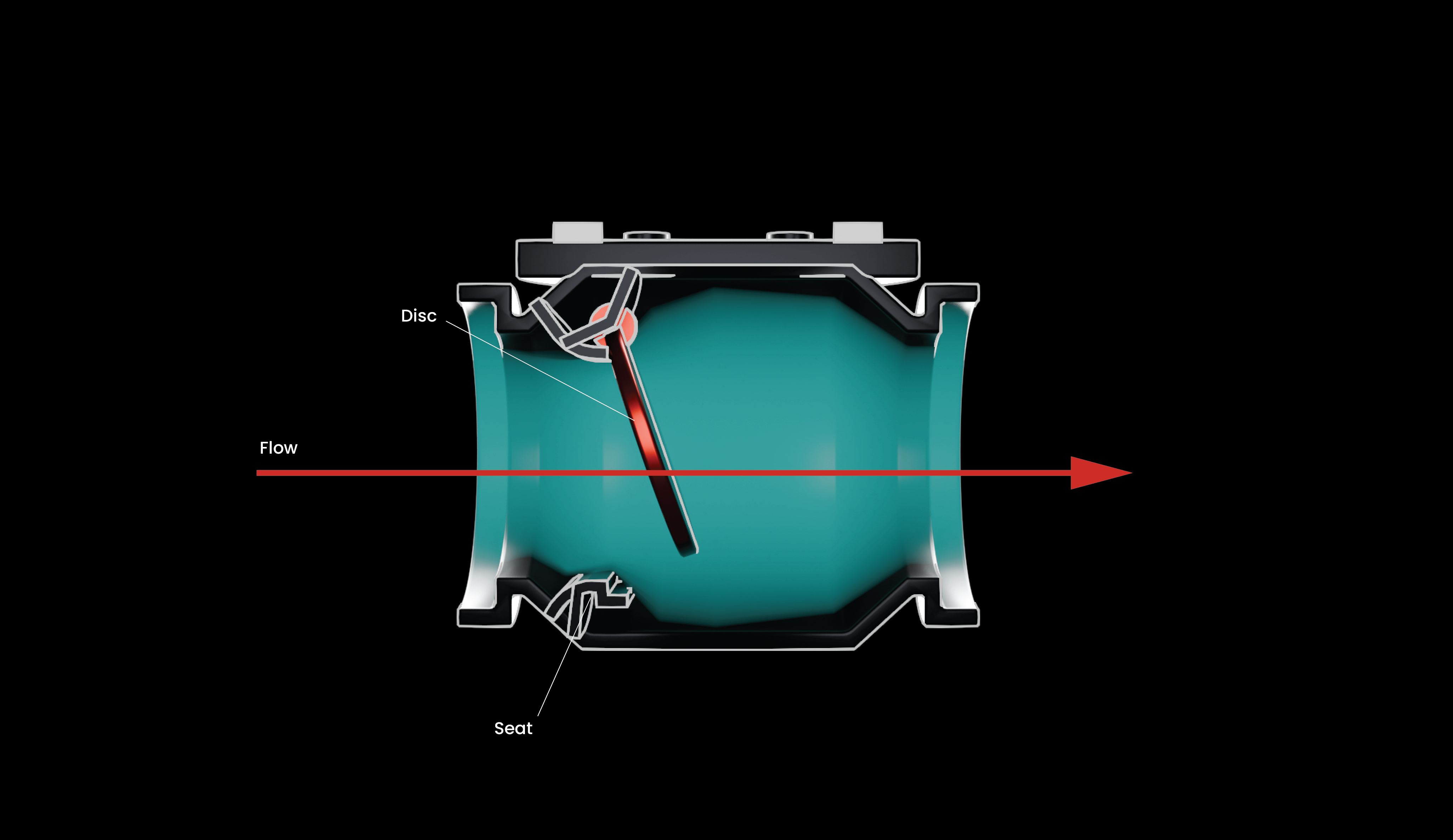
A check valve is passive. It has no actuator. It permits forward flow and closes against reverse flow, protecting upstream equipment from backflow and preventing cross-contamination between process steps. A check valve is defined by two numbers: its cracking pressure (the forward pressure needed to open it) and its ability to reseal and hold against back pressure.
Because they are not actively controlled, check valves are specified by their pressure behavior and their wetted materials rather than by a control scheme.
How do ball and butterfly valves work?
Ball and butterfly valves use a rotating element, a bored ball or a disc, to open or block the flow path with a quarter turn. They are robust, handle high flow at moderate cost, and are the workhorse of large-bore on/off duty in stainless steel systems.
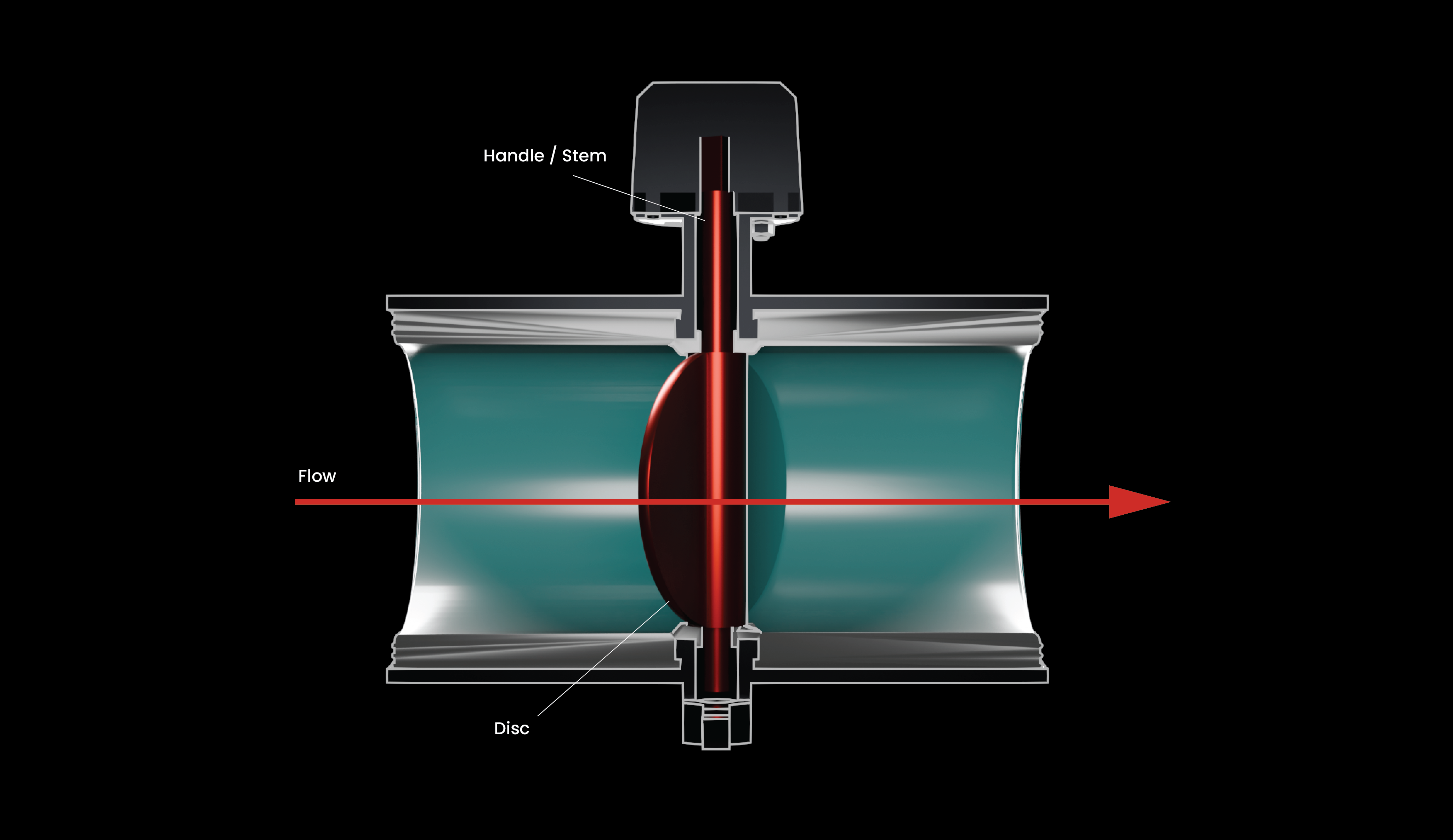
They are not designed for single-use service, and they offer limited fine modulation compared with a diaphragm valve. In a hybrid facility they typically sit on the stainless, multi-use side of the process, the territory covered by the Aquasyn stainless steel range.
Pneumatic vs electric: the choice that matters more than the type
Once a valve needs to be actuated, the actuation method often decides more about process performance than the valve body does. The two options behave very differently.
A pneumatic actuator must pressurize an air volume before the valve moves. Most installed pneumatic valves are run as on/off duty, with position inferred from air pressure rather than measured. Proportional pneumatic valves do exist and can modulate, but air compressibility caps their pressure-control accuracy at several PSI: the gas volume changes faster than the actuator can track. They require a compressed air supply, regulators, and tubing, along with the validation scope that infrastructure carries.
An electric actuator (a stepper motor with encoder feedback) responds in milliseconds, holds any point across the full stroke through microstepping, and knows its exact position at all times. It runs on 24V DC, with no compressed air at all, and it reports position, torque, and current as a live data stream. Encoder-based control reaches roughly plus or minus 0.3 PSI, where air compressibility caps pneumatic proportional control at several PSI.
| Parameter | Pneumatic | Electric (stepper + encoder) |
|---|---|---|
| Response time | Seconds (air-volume dependent) | Milliseconds |
| Position control | Open / close (some proportional) | Continuously adjustable (microstepping) |
| Position feedback | None (inferred from air pressure) | Encoder, exact position always known |
| Pressure accuracy | Several PSI | ±0.3 PSI |
| Infrastructure | Compressed air, regulators, tubing | 24V DC, M12 connector |
| Process data | None, invisible to automation | Position, torque, current, electronic batch records, ISA-88 integration |
| Continuous campaigns | Air supply must be maintained | Capable of long continuous runs, no air supply dependency |
Which valve type belongs where?
A rough map of where each type fits, and where it does not:
| Type | How it works | Best for | Limitation |
|---|---|---|---|
| Diaphragm | Flexible membrane seals against a weir or seat | Precise flow and pressure control in single-use and hygienic systems | Higher cost than pinch; requires a matched actuator |
| Pinch | External mechanism compresses flexible tubing | On/off control and tubing-based single-use systems | Limited fine modulation; tubing fatigues over time |
| Check | Passive; one-way flow, closes against reverse | Backflow prevention, protecting upstream components | No active control; performance set by cracking and reseal pressure |
| Ball / butterfly | Rotating element opens or blocks the path | Stainless steel systems, large-bore on/off | Not single-use; limited modulation |
What matters more than the valve type?
The category name. Every valve datasheet leads with the type and the connection size. Neither tells you whether the valve can hold a setpoint, how fast it responds, or whether it can report what it is doing. Those characteristics, set largely by the actuation, are what determine filtration stability, column protection, and batch-to-batch reproducibility.
The question isn't "pneumatic or electric," or even "diaphragm or pinch." It's "does this valve need to hold a position, with accuracy and feedback, or just open and close?" Answer that honestly, and the actuation and the type have largely been decided by the process itself.
Where to read next
If you are specifying valves for a single-use process, or weighing actuation for a new facility, the deeper articles below cover the specific mechanisms.
How Diaphragm Valves Work
How the diaphragm seals, what sets control resolution, and why material choice matters. Read
How Pinch Valves Work
External compression on flexible tubing, and the trade-offs in precision and tubing wear. Read
Pneumatic vs Electric: What the Spec Sheet Doesn't Tell You
Response time, position accuracy, infrastructure cost, and predictive maintenance. Read
Pump Types in Bioprocessing
The companion comparison across the four pump architectures. Read →
Common questions
What are the main types of bioprocessing valves?
Four valve types dominate hygienic bioprocessing: diaphragm valves (a flexible membrane seals against a weir), pinch valves (an external mechanism compresses flexible tubing), check valves (passive, allowing flow one way and blocking reverse), and ball or butterfly valves (a rotating element opens or blocks the path).
What is the difference between a diaphragm and a pinch valve?
A diaphragm valve seals an integral flexible membrane against a weir inside the valve body. A pinch valve compresses flexible tubing from the outside, with no valve body in the wetted path. Diaphragm valves give finer control; pinch valves are simpler and add no hold-up but trade off precision and tubing life. For choosing between them position by position, see diaphragm valve vs pinch valve.
How does valve actuation differ from valve type?
Valve type is the sealing mechanism (diaphragm, pinch, check, ball). Actuation is how the valve is driven: manually, by compressed air (pneumatic), or by an electric motor with encoder feedback. Actuation, more than type, determines response time, position resolution, and pressure-control accuracy.
The most common valve in single-use bioprocessing. How the diaphragm seals and what determines control resolution.
Standards & further reading
- ASME BPE (Bioprocessing Equipment). The leading standard for the design, materials, surface finish, and documentation of bioprocessing equipment, including hygienic valves.
- ANSI/ISA-88 (Batch Control). The automation standard referenced for recipe-driven control and the integration of intelligent, position-aware valves into batch architectures.